About Echinocereus viridiflorus subsp. chloranthus (Engelm.) N.P.Taylor
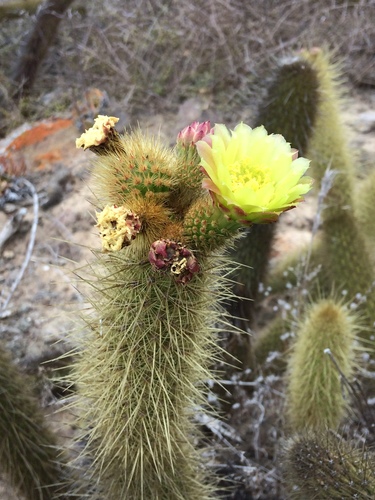
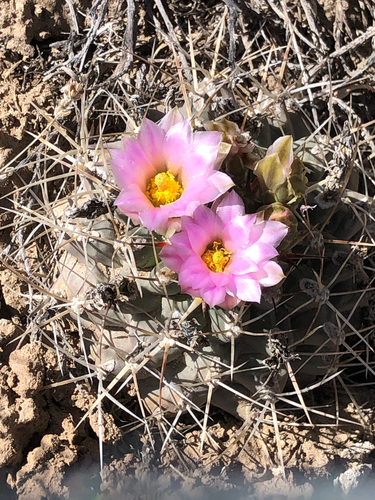
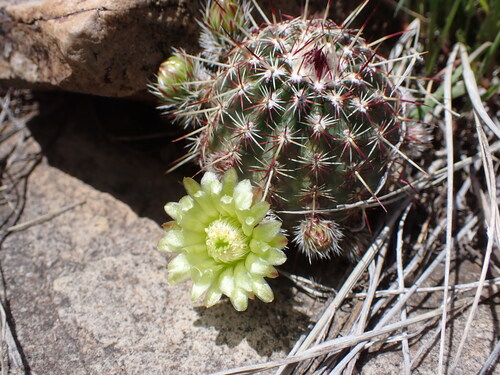
This subspecies of cactus has a small stem that ranges from spherical to ovoid in shape, and may sometimes be elongated or cylindrical. The stem grows between 3 cm (1.2 in) and over 30 cm (12 in) tall, and reaches 1 to 9 cm (0.39 to 3.54 in) wide. It has 6 to 18 ribs that form distinct humps. The plant is mostly unbranched, but may form low, squat clusters of multiple branches. Its ribbed body is lined with numerous areoles that bear spines. These spines can be red, yellow, white, purplish, or bicolored, sometimes with darker tips, and grow up to 2.5 cm (0.98 in) long. There are 8 to 24 marginal spines, which may also be red, cream, or brown, and reach up to 1.8 cm (0.71 in) in length. The flowers are up to 3 cm (1.2 in) long, with tepals that come in yellowish, brownish, greenish, or occasionally red shades, with darker reddish midstripes. Tepal tips are thin, and flowers are typically funnel-shaped, wide open, and green to yellow-green, measuring 2.5 to 3.0 cm (0.98 to 1.18 in) long with a large diameter. Fruits are spherical, green, and heavily thorny. The parent species Echinocereus viridiflorus is widespread across the US states of South Dakota, Wyoming, Colorado, Kansas, New Mexico, Oklahoma and Texas, as well as the neighboring Mexican states of Coahuila and Chihuahua, and has yellow-green flowers. This rare subspecies is endemic to Brewster County, Texas, where it grows among Selaginella in rocky novaculite-derived soils. As of 1984, only one population was known, and the subspecies is unlikely to expand its range, as it is restricted to this specific mineral substrate.