About Echinocereus salm-dyckianus Scheer
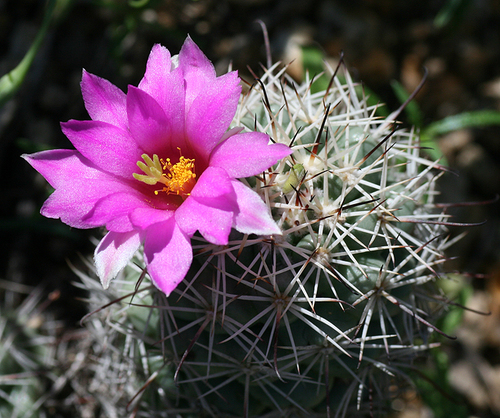
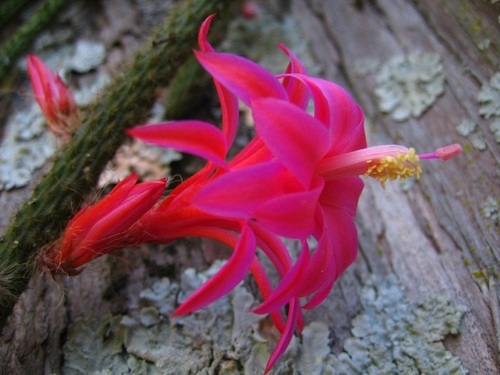
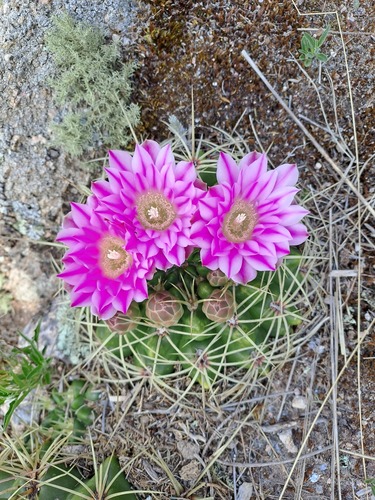
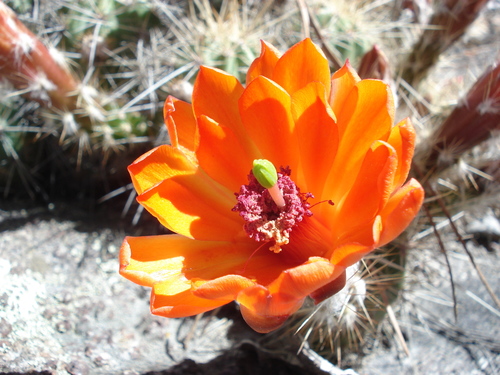
Echinocereus salm-dyckianus Scheer is a clumping, columnar cactus that produces up to 97 shoots. Its cylindrical stems taper toward the tip, measure 10 to 16.5 cm (3.9 to 6.5 in) long, and have a diameter of 2.9 to 5.2 cm (1.1 to 2.0 in). This species has seven to ten straight, slightly bumpy, distinctly blunt ribs. It bears 8 to 12 yellow to reddish brown radial spines, plus two to four central spines. The central spines are terete, longer and thicker than the radial spines, and reach 4 to 25 mm (0.16 to 0.98 in) in length. The flowers are tubular-funnel-shaped, pink to orange-apricot with a magenta interior. They emerge from sharply pointed buds along the sides of the shoots, are 8 to 10.3 cm (3.1 to 4.1 in) long and 4.4 to 6.5 cm (1.7 to 2.6 in) in diameter, and have a hairy floral tube covered in white woolly hairs. Echinocereus salm-dyckianus is pollinated by hummingbirds, and its flowers open both during the day and at night. The fruit is round, 20 to 24 mm (0.79 to 0.94 in) long, greenish brown with white flesh and black seeds. The chromosome count for this species is 4n=44. Echinocereus salm-dyckianus is native to Mexico, where it occurs in Sierra Saguaribo in eastern Sonora, and in Sierra Charuco, Rio Haciendita, La Bateria, Nabogame, and Sierra Obscura in western Chihuahua. It grows in the Sierra Madre Occidental at elevations between 1699 and 2431 meters, found in shaded canyons and rocky slopes alongside Echinocereus rigidissimus subsp. rubispinus, Echinocereus stolonifer, Echinocereus stolonifer subsp. tayopensis, and Echinocereus polyacanthus.