About Echinocereus rigidissimus (Engelm.) Hirscht
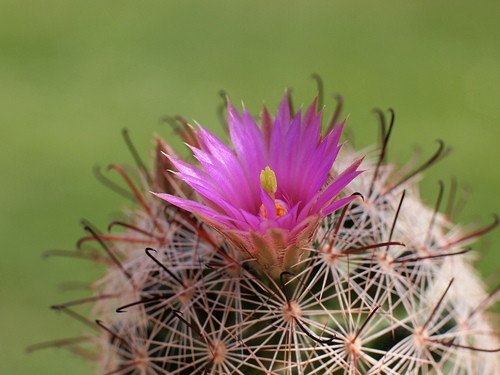
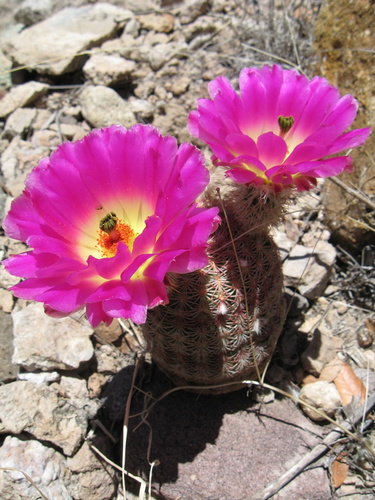
When mature, Echinocereus rigidissimus reaches a height of 6 to 30 cm and a width of 4 to 11 cm. It has pectinate radial spines that curve slightly toward the stem, and 15 to 26 low, flatly tuberculated ribs. No central spines are formed. New spines start out reddish to magenta, and fade to yellow or light pink as they mature. Echinocereus rigidissimus produces flushes of flowers throughout spring, with multiple buds growing on top of the plant from younger areoles. Flowers are bright pink with a white throat, form at the tips of shoots, and measure 6 to 7 cm long with a diameter of 6 to 9 cm. If pollination is successful, this species produces round, greenish to dark purplish fruit with white flesh and dark brown to black seeds around 3 months after flowering. Echinocereus rigidissimus rarely offsets, so it is typically propagated by seed. In its natural habitat, Echinocereus rigidissimus is abundant across Chihuahua and Sonora in Mexico, and in Arizona and New Mexico in the United States. It grows at elevations between 1200 and 2000 metres above sea level, with a preference for elevations around 1500 metres. This cactus favors south-facing slopes and is rarely found on flat ground. Individual plants can resist small grass fires, but cannot survive hotter fires. In ideal habitat, Echinocereus rigidissimus has been recorded growing up to 45 centimetres tall. A 2018 measurement of an individual in the Santa Catalina mountains recorded a height of 48 centimetres, which is the current record. Flowering takes place from late April to early June, varying based on elevation and spring temperatures. Plants do not flower when stressed, but this lack of flowering is rare. The species' native habitat has been negatively impacted by cattle grazing, cactus collection, and off-road vehicle use, and populations are declining in southern Arizona. In cultivation, Echinocereus rigidissimus needs porous soil because it is sensitive to overwatering. It prefers a stony soil with low organic content, to ensure the growing medium dries as quickly as possible. During its active growing season from spring through to early autumn, it requires full sun to part shade, plus adequate air circulation to lower the risk of rot. Watering should be stopped entirely in winter, and the growing medium kept dry; this practice encourages spring flowering. Echinocereus rigidissimus is hardy to temperatures as low as −12 °C.