About Echinocereus reichenbachii (Terscheck) F.Haage ex Britton & Rose
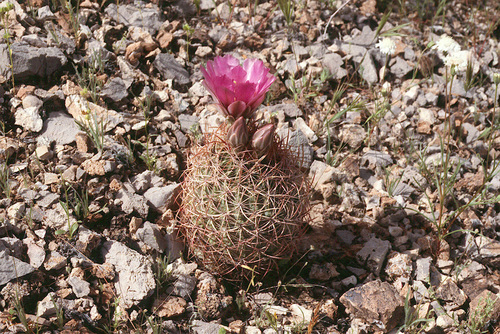
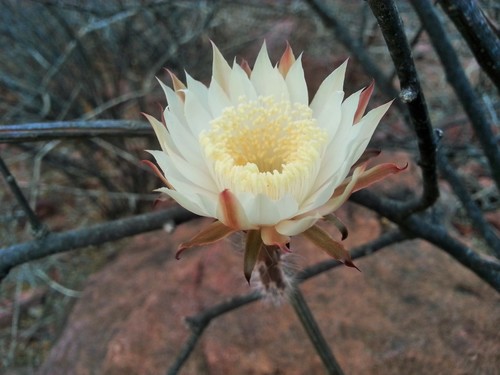
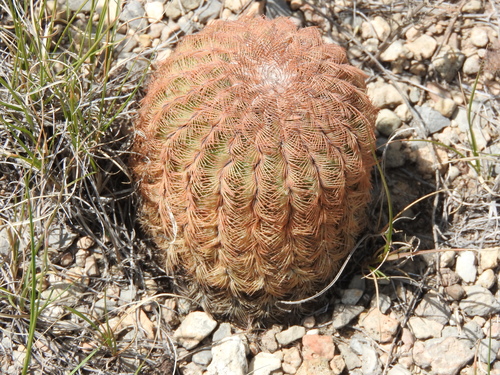
Echinocereus reichenbachii (Terscheck) F.Haage ex Britton & Rose is a perennial shrubby cactus, and one of the smaller species in the Echinocereus genus. Immature individuals are spherical, becoming cylindrical as they mature. Plants grow either solitary or as multi-branched clusters with up to twelve individuals, bearing erect stems that have 10 to 19 slightly undulate ribs. Mature plants reach 7.5 to 30 centimetres (3.0 to 11.8 in) tall and 4 to 10 centimetres (1.6 to 3.9 in) wide. Their dark green stems are obscured by spines, especially when the plant is dehydrated. Areoles are elliptical or oval, spaced 1 to 6 millimetres (0.039 to 0.236 in) apart, and each holds 15 to 36 spines. Spines range in color from tan to brown, black, purplish black, or pink, with tips usually darker than the shaft; central spines tend to be the darkest. Each areole can have up to 7 central spines, which measure 1 to 6 millimetres (0.039 to 0.236 in) long. Flowering occurs between early May and late June, and fruits develop 6 to 10 weeks after flowering. Individual flowers only open for one day, but flowering is staggered so a plant will have open blooms for a full week. Buds are covered in white wool that conceals the developing fruit as it grows. Flowers are purple or pink, growing to approximately 4.5 to 8 centimetres (1.8 to 3.1 in) by 5 to 10 centimetres (2.0 to 3.9 in). Inner tepals are silvery pink or magenta, while outer portions are white, crimson, green, or multicolored. Flower tubes measure 22 to 40 millimetres (0.87 to 1.57 in) by 10 to 30 millimetres (0.39 to 1.18 in); tube hairs are 5 to 15 millimetres (0.20 to 0.59 in) long, and the nectar chamber is 2 to 5 millimetres (0.079 to 0.197 in) deep. Each flower has 30 to 50 ragged or notched petals. Pistils are multi-lobed and green, while stamens are cream-colored or yellow. Fruits come in various shades of green and measure 15 to 28 millimetres (0.59 to 1.10 in) long. The native range of E. reichenbachii covers the entire Chihuahuan Desert, adjacent grasslands, and oak and juniper woodlands, growing at elevations up to 1,500 meters (4,900 ft). In the United States, it is native to Texas, New Mexico, Colorado, Nebraska, Kansas, and Oklahoma. In northern Mexico, it is native to the states of Coahuila, Nuevo León, and Tamaulipas. The Oklahoma variety E. reichenbachii baileyi has distinctively long bristlelike spines. E. reichenbachii tolerates both cold and heat, and prefers dry, well-drained soils near rock outcroppings in its native habitat. In cultivation and propagation, E. reichenbachii prefers full sun and requires very little water. It thrives in dry, well-drained gravelly, clay, and loam soils, and also grows well near rock outcroppings and under glass. It is drought resistant, but susceptible to infestation by mealybugs and scale insects. Propagation is done using seeds collected when fruits begin to dry. This species is used as an ornamental plant in commercial landscaping, especially for desert climate gardens. It is considered deer resistant, and has received the Royal Horticultural Society's Award of Garden Merit.