About Echinocereus fendleri (Engelm.) Sencke ex J.N.Haage
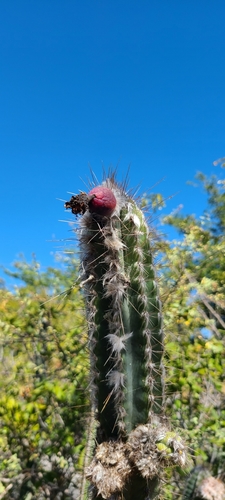
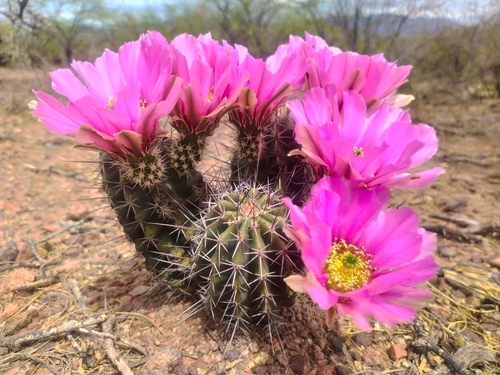
Echinocereus fendleri (Engelm.) Sencke ex J.N.Haage most often grows solitary, with an erect oval or cylindrical stem, and sometimes forms a clump of several spreading stem branches. The stem reaches a maximum height of 7.5 to 30 cm (3.0 to 11.8 in) and a diameter of 3.8 to 6.2 cm (1.5 to 2.4 in). It has eight to ten non-tuberculated ribs. Each areole has up to 16 spines, generally in shades of brown and white, or white with a brown stripe. A single dark central spine, which may be absent, is straight or slightly curved, lightens with age, and measures 1.2 to 3.8 cm (0.47 to 1.50 in) long. Five to nine light-colored, spreading, straight marginal spines measure 0.9 to 1.2 cm (0.35 to 0.47 in) long. The showy flower comes in almost any shade of pink, from nearly white to deep maroon. It can reach 11 cm (4.3 in) in length and width, with each tepal growing up to 7 cm (2.8 in) long. The fruit is spherical, red, and a few centimeters long. The plant’s flesh is edible, and Native American groups consumed its stems and fruits. This species is found in the United States (Arizona, New Mexico, Colorado, Texas) and the neighboring Mexican states of Sonora and Chihuahua. It grows on dry slopes and in rocky limestone areas within semidesert grasslands, chaparral, and coniferous-oak woodlands, at elevations of 900 to 2400 meters.