About Echinocereus engelmannii (Parry ex Engelm.) Lem.
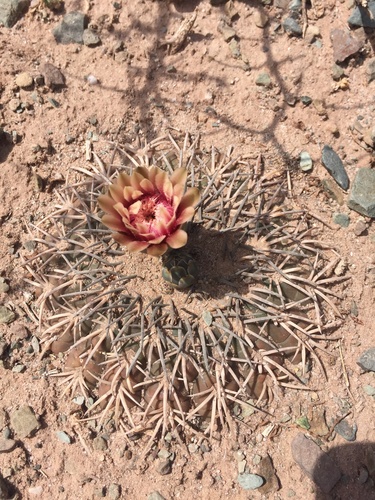
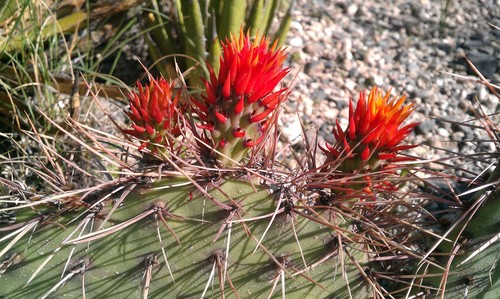
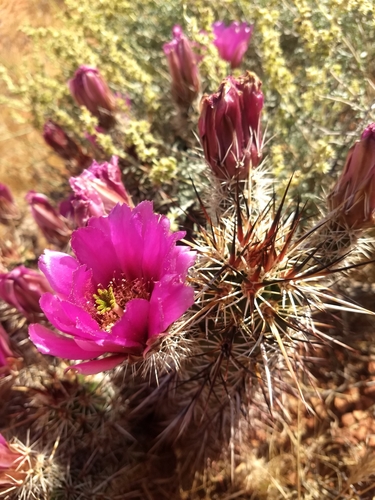
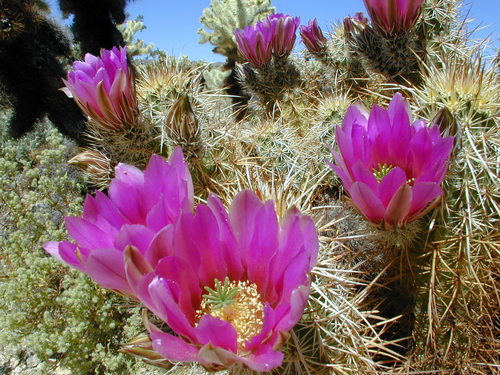
Echinocereus engelmannii, commonly called Engelmann's hedgehog cactus, most often grows in clusters that can sometimes hold 20 or more stems. Its bright magenta flowers bloom between April in the southernmost parts of its range and late May in its northern locations. Flowers grow on the upper third to upper half of the stem, are funnel-shaped, and can reach up to 8.9 cm (3.5 inches) long, with dark-green stigmas. The fruit of this cactus is spiny. When young, the fruit is green; it turns pink as it ripens and dries at full maturity. Ripe fruits have spines that detach easily. Seeds are black and measure roughly one tenth of an inch across. Young plants have initially cylindrical, erect stems; as the plant matures, the base of the stem lies flat against the ground. Mature stems are usually 3.8 to 8.9 cm (1.5 to 3.5 inches) in diameter and up to 64 cm (25 inches) tall, and they are completely obscured by heavy spines. Plants typically have around 10 somewhat flattened, tuberculate ribs. Spines of this species vary widely in both color and size. Short, needlelike radial spines reach up to 2.0 cm (0.8 inches) long, are white, and arranged in a distinct neat rosette. There are 2 to 7 central spines; these are stout, usually twisted and angular, and can grow up to 7.6 cm (3 inches) long. Central spines come in a range of variable colors: bright yellow, dark brown, grey, and white. The haploid chromosome count for this species gives a somatic count of 2n=44. Engelmann's hedgehog cactus is one of the most common cactus species found in the southwestern United States (including southern California, Arizona, southern Nevada, and Utah) and Mexico (from Baja California down to northern Baja California Sur, and Sonora), growing at elevations between sea level and 2400 meters. There are multiple recognized varieties of Echinocereus engelmannii, some of which are rare. It grows in a variety of dry habitats, normally in well-drained areas. Habitats include the Sonoran and Mojave deserts, chaparral, pinyon-juniper woodlands, grasslands, and Great Basin shrub communities. It can be found on sandy plains, in desert washes and canyons, on gravelly, sandy, or rocky hillsides, and within mountain ranges. The native vegetation of this cactus's range includes Ferocactus cylindraceus, Cochemiea grahamii, Cochemiea tetrancistra, Echinocereus scopulorum, Fouquieria species, Larrea tridentata, Parkinsonia microphylla, Fouquieria columnaris, Cylindropuntia leptocaulis, Cylindropuntia ramosissima, and Opuntia engelmannii, alongside many other species. The species remains abundant across its entire native range. Echinocereus engelmannii is used as a landscape plant within its native region. When grown in potted culture, this species needs a well-aerated gritty growing substrate and a hot, sunny location through the summer. During the winter, it can tolerate light frost and moist soil as long as the soil is well-drained. When grown in cultivation, this species typically does not produce blooms until it has grown 2 to 3 branches.