About Echinocereus coccineus subsp. coccineus
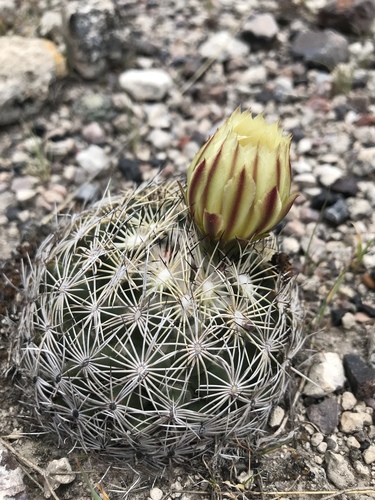
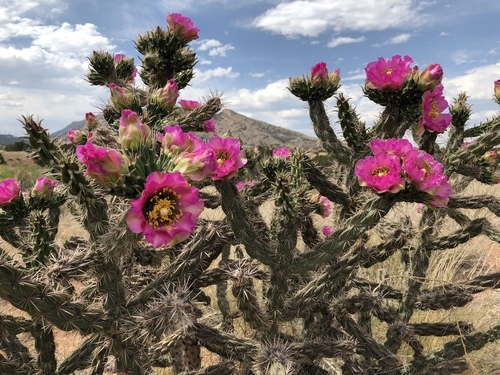
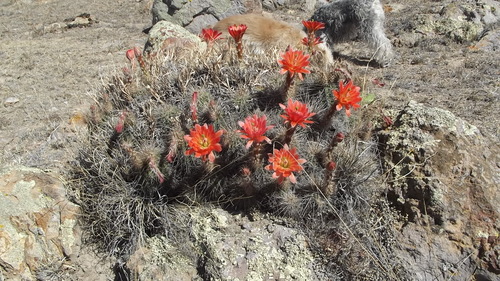
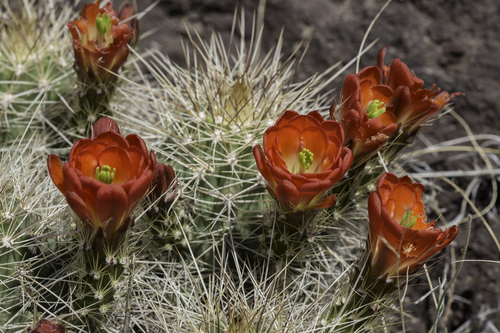
This usually branched cactus forms small mounds made up of around 30 stem clumps, and can reach up to one meter in diameter. Its light green stem body is egg-shaped to cylindrical, growing up to 40 centimeters tall, with a diameter between 2.5 and 5 centimeters. It has 11 to 14 ribs that often form warts. Its spines range in color from yellow to blackish red. There are 4 to 7 central spines (which may also be absent), these have an angular cross-section, grow up to 7 centimeters long, and the middle central spine is often flattened. It has 5 to 20 radial spines that are round at the base, and measure 1 to 4 centimeters long. Flowering occurs from late spring to early summer. Flowers are most commonly red, yellow, pink, purple or white; broad, funnel-shaped orange-red flowers appear below the shoot tip, and are sometimes dioecious. Flowers measure 3 to 10 centimeters long, with a diameter of 2.5 to 8 centimeters. After flowering, it produces edible spherical fruits that turn red, and have falling spines. The chromosome count for this subspecies is 4n=22. Echinocereus coccineus is distributed in the southern United States states of Colorado, Arizona, New Mexico, and western Texas, and ranges south through the Sonoran Desert to the Mexican states of Coahuila and Chihuahua, growing at elevations between 685 and 1775 meters.