About Echinocereus acifer (Otto ex Salm-Dyck) Haage
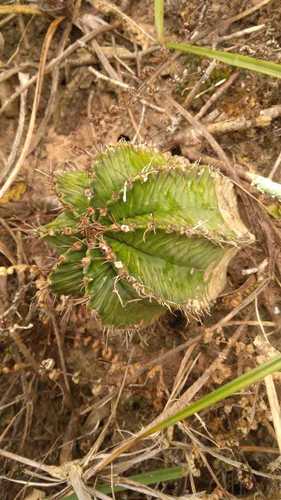
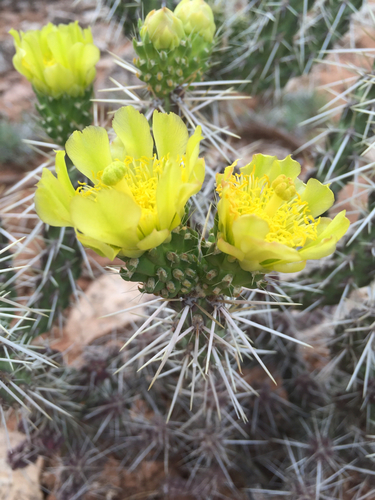
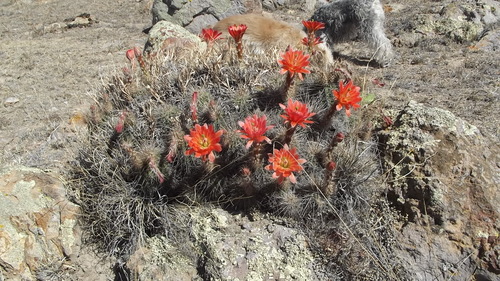
Echinocereus acifer (Otto ex Salm-Dyck) Haage branches from the base, forming small cushions made up of 5 to 8 individual stems. Its dark green, cylindrical stem body reaches 10 to 40 cm (3.9 to 15.7 in) in height and 5 to 10 cm (2.0 to 3.9 in) in diameter. The species has 9 to 12 thick, warty tuberous ribs. On new growth, tomentose areoles are spaced 1 to 1.5 cm (0.39 to 0.59 in) apart, and measure approximately 3 mm (0.12 in) in diameter. Its spines are yellow to reddish-brown, fading to gray as they age; there are up to 5 central spines, surrounded by 10 to 15 radiating marginal spines. Flower buds develop from a woolly white pad that bears reddish-brown bristles. The funnel-shaped flowers are red on the outer surface and yellow on the inner surface, rarely irregularly curved. They grow 8 to 12 cm (3.1 to 4.7 in) long, with a maximum diameter of 10 cm (3.9 in). Unlike the monoecious flowers of the related species Echinocereus polyacanthus, the flowers of Echinocereus acifer are hermaphroditic and self-pollinating. This species has yellow stamens, and a green to light green stigma. Its oval fruits stay greenish, measuring 2 cm (0.79 in) in diameter and 3 cm (1.2 in) in length. Echinocereus acifer occurs in the Mexican states of Guanajuato, Zacatecas, San Luis Potosí, and Durango, where it most often grows in rocky forest habitats, within moss, or in rock crevices.