About Echinocactus polycephalus Engelm. & J.M.Bigelow
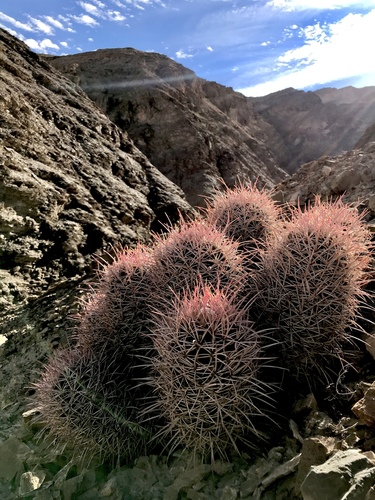
This cactus, currently classified as Echinocactus polycephalus Engelm. & J.M.Bigelow and previously referred to as Homalocephala polycephala, sometimes grows with solitary stems, but more often forms clusters containing up to 30 stems. Mature stems grow 30 to 60 centimeters tall and 10 to 20 centimeters in diameter, and are marked with 13 to 21 ribs. Each areole produces four central spines that are reddish with a faint purplish hue, turning gray as they age. These central spines are irregularly arranged: the lowest spine curves downward, while the other central spines are generally straight and crisscrossed. Central spines reach 6 to 7.5 centimeters in length; overall spines of this cactus range in color from yellow to red. Each areole also produces 6 to 8 radial spines, which are also irregularly distributed, similar in appearance to the central spines, and measure 3 to 4.5 centimeters long.
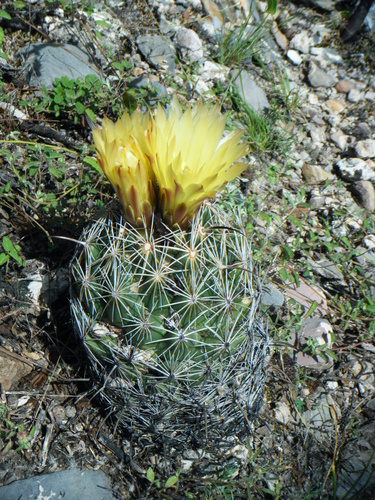
This cactus produces yellow flowers, each with a pink central stripe, that measure approximately 5 centimeters in both length and diameter. Its fruits are densely woolly, covered in white hairs, and measure 1.2 to 2 centimeters long; this woolly fruit gives the species its common name cotton top cactus. Its common tendency to grow in clustered stems gives it the other common name many-headed barrel cactus. This species has a reputation as difficult to cultivate, so it is rarely found in private or public cactus collections.
This cactus occurs in the Mojave Desert region of Arizona, California, and Nevada in the United States, and also grows in the Sonoran Desert region of southern California (U.S.) and northern Sonora (Mexico). It grows on rocky hills and slopes at elevations between 30 and 750 meters, and can be found in some of the most extreme arid environments of the American Southwest, including Death Valley National Park and the Mojave National Preserve in Southern California.