About Echinocactus horizonthalonius Lem.
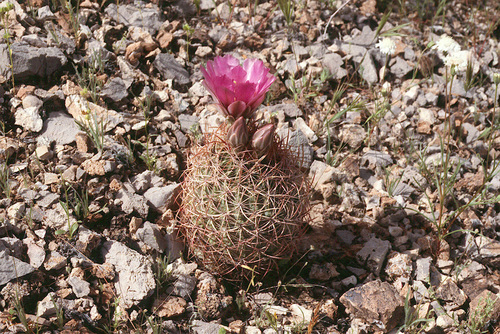
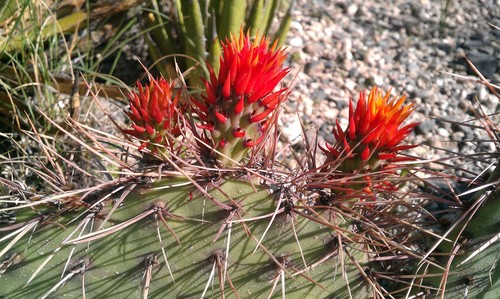
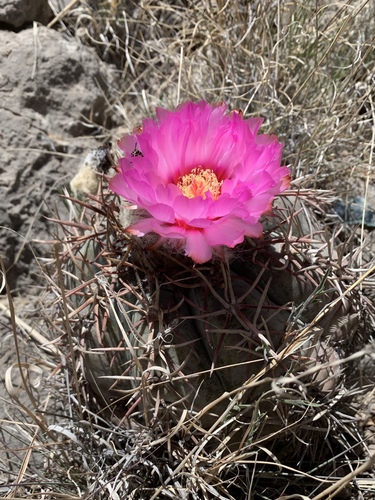
This cactus species ranges in color from gray-green to blue-green, and can take a spherical, hemispherical, columnar, or flat-topped shape. It grows to a maximum size of roughly 45 centimeters tall by 20 centimeters wide. Its body is formed by curved segments that twist helically around the plant. These segments are lined with areoles, each holding up to 10 spines. The spines, which can be pink, gray, or brown, may grow over 4 centimeters long. The plant produces bright pink to magenta flowers that reach 7 to 9 centimeters wide. Flowers open around midday, close at night, and also open after the plant gets rainfall. While most blooms appear in June, the plant may bloom again in late summer and fall if rainfall occurs. The fruit is hairy or woolly, and pink or red in color. The species is generally split into two varieties. The more common variety, Echinocactus horizonthalonius var. horizonthalonius, grows in Chihuahuan Desert habitats, ranging from Arizona through New Mexico into Texas and northeastern Mexico. The rare variety, Echinocactus horizonthalonius var. nicholii, commonly called Nichol's turk's head cactus, is only known from three Sonoran Desert populations in southeastern Arizona and one population in Sonora, Mexico. It is federally listed as an endangered species in the United States. Some of its populations are protected within Ironwood Forest National Monument, located in Pinal and Pima counties, Arizona. Threats to this variety include limestone mining, off-roading, and collection of wild specimens for their showy flowers. Buffelgrass is also a major threat, as it introduces more frequent fire to the landscape. Conservation efforts for this rare variety have seen some success, primarily through buffelgrass suppression.