About Echinacea pallida (Nutt.) Nutt.
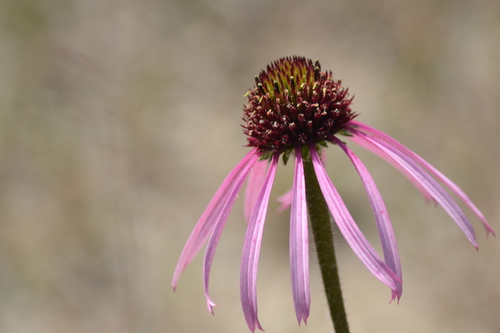
Echinacea pallida (Nutt.) Nutt. is similar to Echinacea angustifolia, but typically grows taller, reaching 1.5 to 2.5 feet (45 to 75 cm), with some individuals growing 3 feet (90 cm) or taller. In the wild, plants usually produce a single unbranched stem, but they often form multi-stemmed clumps when grown in gardens. They have deep, spindle-shaped taproots, which are wider at the center and taper at both ends. Stems are solid green, or mottled with a mix of purple and green. Leaves are elongated lanceolate or linear-lanceolate with three veins, and are concentrated near the base of the stem. Flower head ray florets are narrow, linear, elongated, and drooping, and measure 1 to 3 inches (2.5 to 7.6 cm) long. Whole flower heads range from 3⁄4 to 3 inches (1.9 to 7.6 cm) wide, and bear pale rose-purple or nearly white ray florets. The flowers produce white pollen. Echinacea pallida blooms from May through July. Its fruits are cypselae, which are tan or bi-colored with angled edges. This species is native to the Mississippi Valley, the southeastern Great Plains, and the area south of Lake Michigan. Most confirmed populations occur between southern Wisconsin and Iowa in the north, and Louisiana and eastern Texas in the south. Additional reports of the species, many of which are likely from human introductions, come from the Southeastern United States, New England, New York, Michigan, and Ontario. Echinacea pallida grows in prairies and prairie remnant habitats, and requires full sun and well-draining soil. Though it prefers moist soils, its long taproot makes it drought tolerant. It is often found growing alongside roads. The state of Tennessee lists E. pallida as endangered, while Wisconsin lists it as threatened; this status is primarily due to habitat loss and over-collection of its roots for use in herbal medicine. No positive health effects from the use of Echinacea as a medicinal plant have been scientifically demonstrated. Echinacea pallida acts as a larval host plant for the silvery checkerspot butterfly.