About Echinacea atrorubens (Nutt.) Nutt.
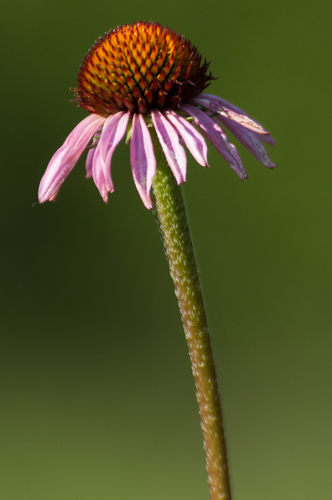
Echinacea atrorubens, commonly known as the Topeka purple coneflower, is a North American flowering plant species belonging to the Asteraceae family. It is native to eastern Kansas, Oklahoma, and eastern Texas, located in the south-central United States. It naturally grows in dry soils on or around limestone or sandstone outcroppings, as well as in prairies. E. atrorubens is a perennial herb that reaches up to 90 centimeters (3.0 ft) in height. It has elongate-turbinate roots that are sometimes branched. Stems and foliage are usually covered in strigose hairs: appressed to ascending hairs that measure 1.2 mm long. Rarely, some individual plants are glabrous, with no hairs. The stems are light green or tan, and have a mottled coloration. Basal leaves have petioles that are 0–12(–20) cm long. Leaf blades are typically 3 or 5-nerved, and are usually linear or lanceolate, rarely ovate. They measure 5–30 cm (2–12 in) long and 0.5–3.0 cm (0.20–1.18 in) wide, and their margins are normally entire. Flowering for this species occurs in late spring. The flowering stems (peduncles) are 20–50 cm (8–19.5 in) long, and usually bear only one flower head at their tip. The characteristic flowering cones have paleae 9–15 mm long; palea tips are red to orange, usually straight, and end in a prickly point. Ray flower corollas are purple, and very rarely can be pink or white. The discs (cones) are ovoid to conic, measuring 25–35 mm wide and 20–40 mm tall. Disc corollas are 4.5–5.5 mm long, with greenish to pink or purple lobes. Seed cypselae are tan, 4–5 mm long, with finely tuberculate, glabrous faces. This species has 11 chromosomes.