About Echinacea angustifolia DC.
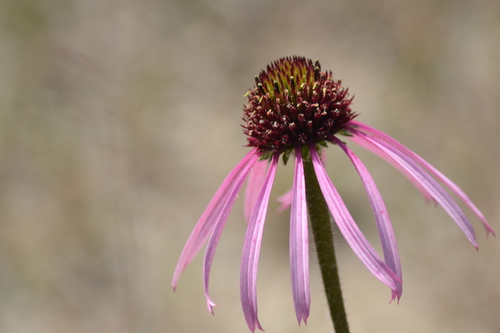
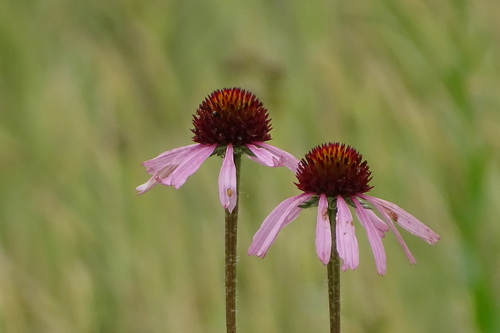
The genus name Echinacea comes from the Greek word echinos, meaning sea urchin or hedgehog, a reference to the spiny appearance of this plant's flower head. Echinacea angustifolia DC. has an overall height of 10 to 50 cm. Its ray petals range in color from white to pink or deep purple, and characteristically wilt downward, while the central disk of the flower head is colored from green to red-brown. Its leaves are dark green, and shaped either oblong-lanceolate or elliptical. It has pubescent stems and underground rhizomes. This species grows in drier regions of tallgrass prairie, mixed grass prairie, and shortgrass prairie across North America, and tolerates a variety of soil types ranging from rocky to sandy-clay. The USDA Natural Resources Conservation Service PLANTS database records this species growing in Colorado, Iowa, Kansas, Louisiana, Manitoba, Minnesota, Missouri, Montana, Nebraska, New Mexico, New York, North Dakota, Oklahoma, Saskatchewan, South Dakota, Texas, and Wyoming. The Flora of North America mostly agrees with this distribution, but does not list the species as present in New York; PLANTS only records the species in Monroe County, New York. Echinacea angustifolia cannot self-pollinate, and requires bee pollinators to reproduce. Pollination is more successful when mating individual plants are located close to one another. This is an herbaceous perennial plant that lives more than two years and produces flowers annually. It grows slowly, and is drought-resistant, an adaptation that helps it survive in its native temperate grassland habitat. Wildflower gardening writer Claude A. Barr considered this species, commonly called narrow-leaved purple coneflower, to be "bold, spectacular, and beautiful." Barr disagreed with its common name, noting that most individuals have flowers that are pink rather than purple. While the plant prefers gravelly or stony soils in the wild, it grows well in standard garden soil as long as it is not crowded by other plants. It is most commonly propagated by seed, but can also be grown from 10-centimeter sections of taproot taken from young plants. To encourage new root and top growth, root cuttings are placed upright under 2 to 3 centimeters of soil with controlled moisture levels.