About Dyssodia papposa (Vent.) A.Hitchc.
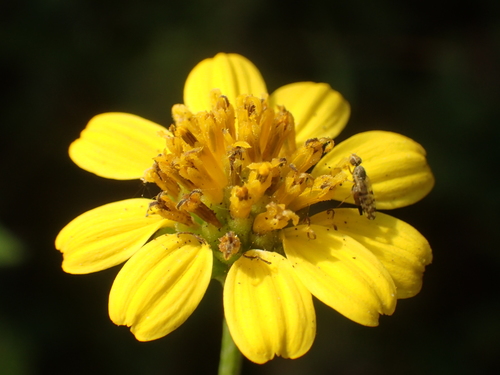
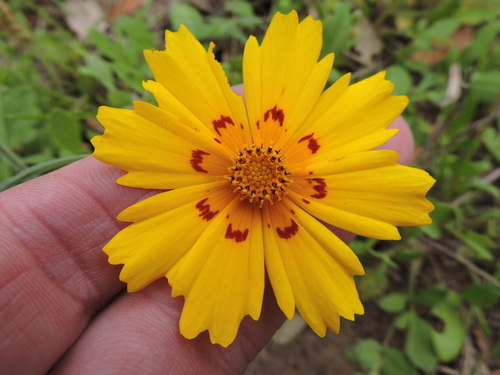
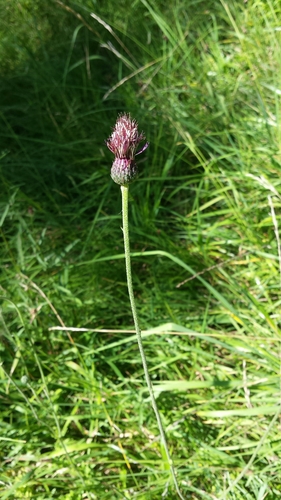
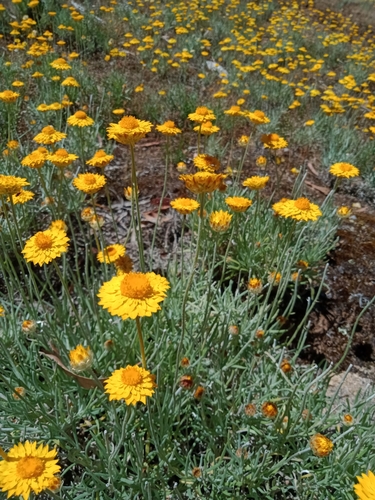
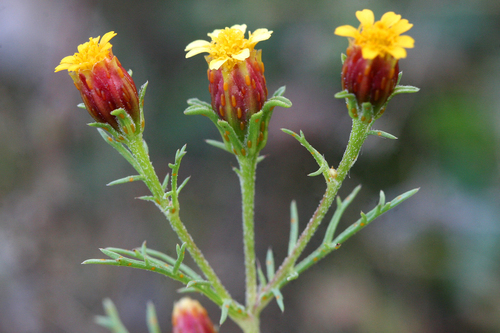
Dyssodia papposa (Vent.) A.Hitchc., commonly called fetid marigold, is an erect, multi-branching annual plant with a large taproot. It grows in anthropogenically disturbed areas such as roadsides, fields, and meadows, at elevations between 3000 and 6500 ft (914–1981 m). It reaches a height of 4–16 inches (10–41 cm; this note corrects the original conflicting 5–70 cm range, as 4–16 inches equals ~10–41 cm). Its leaves are simple, oppositely arranged, 15–50 mm (3/4 in to 2 in) long, and linearly lobate. The flowers have the combined disk and ray structure typical of the Asteraceae family; both disk and ray flowers are yellow-orange, and the entire flower structure is up to 1/2 inch long. The flower head holds 5–8 ray flowers, which are up to 3.5 mm long and 1.5 mm wide (corrected from the original implausible centimeter measurement). It also has tubular disk flowers, with greenish outer and inner bracts. Mature seeds are small, hairy, narrowly conical, dark brown, and have a tuft of bristles at the top. Distinctive orange odor glands dot the stalk, leaves, and stems of the plant; these glands produce the plant’s characteristic scent. It flowers from summer through fall. The generic name Dyssodia comes from the Greek word dusodia, meaning "bad odor," while the specific epithet papposa comes from Latin, meaning "with pappus." Its native range covers the central plains of North America, parts of the Southwestern United States, and extends into the Northeastern United States. It has recently been documented growing in Canada, where it is expected to expand its range through adventitious growth. Ecologically, this plant acts as a host for the dainty sulphur butterfly. It is commonly found in prairie dog towns, and is one of the prairie dogs’ preferred food sources.