About Dysphania militaris (Linnaeus, 1758)
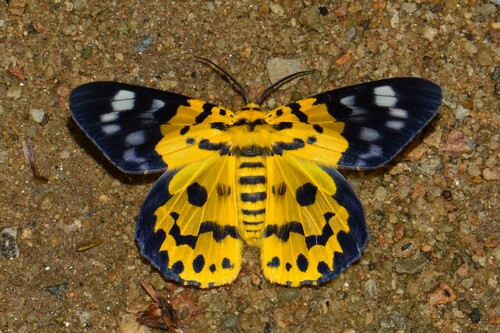
This species has a wingspan of approximately 80–96 mm. Males have produced, long and narrow forewings, with a strongly developed fovea. The head, thorax, and abdomen are golden yellowish with purplish bands. The basal half of the forewings is golden-yellow, while the outer half is deep purplish, with an irregularly sinuous inner edge. Two oblique basal purple fasciae are present; the lower fascia sometimes has a spot detached from it. Two spots are located on the costa near the base. An oblique antemedial series of three spots is often conjoined. The outer area has two pale blue maculate bands, with the outer band ending at vein 3. Hindwings are golden yellow, with a large purple discocellular spot and a spot below the cell. A postmedial lunulate band curves outward between veins 3 and 5. A submarginal series of spots becomes large, conjoined lunulate patches at the apex. Spots on the yellow areas are very variable in appearance. Dysphania militaris flies during the day, and its bright coloration often leads to it being mistaken for a butterfly. Multiple similar species, including Dysphania subrepleta, live in the same region, and some of these species are very closely related. Dysphania alloides, first described from the Andaman Islands, was originally classified as a subspecies of Dysphania militaris. Larvae of this moth have been recorded feeding on plants from the genera Carallia, as well as the species Kandelia candel and Rhodomyrtus tomentosa.