About Dypsis lutescens (H.Wendl.) Beentje & J.Dransf.
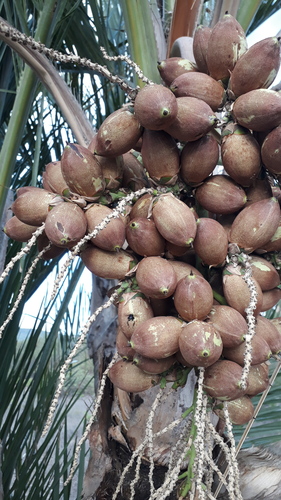
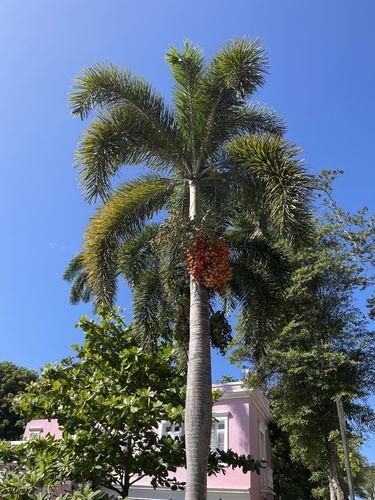
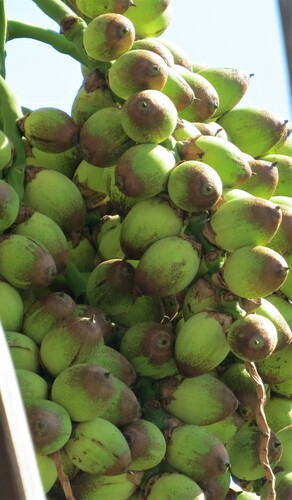
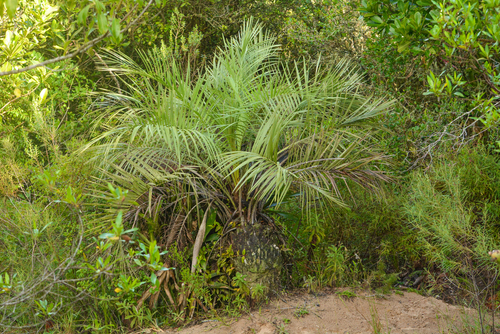
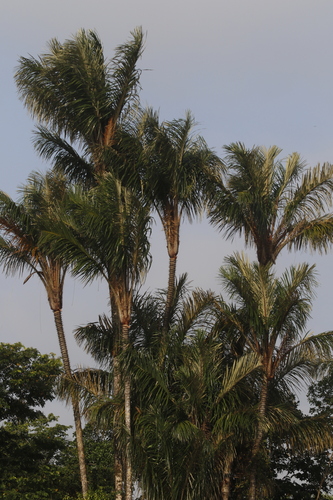
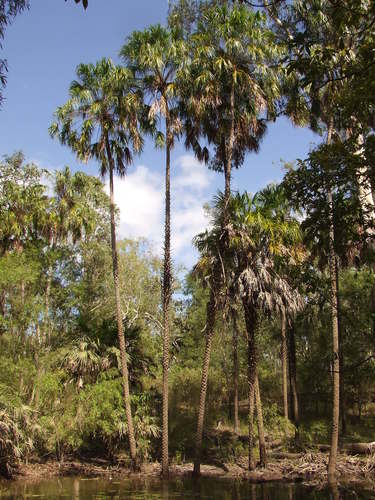
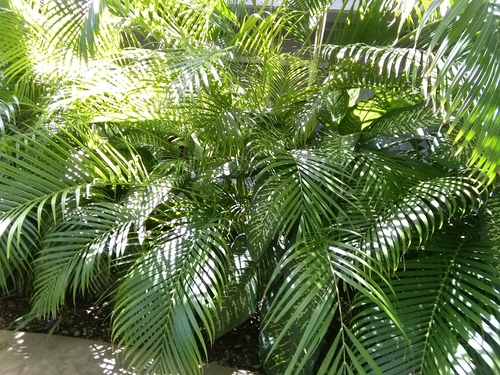
Dypsis lutescens, previously known as Chrysalidocarpus lutescens, is a perennial tropical palm. It reaches 6–12 m (20–39 ft) in height, and spreads 3–5 m (8–15 ft) wide. Multiple cane-like stems grow from its base, forming an overall vase-like shape. Its leaves are upward-arching, pinnate, 2–3 m (6 ft 7 in – 9 ft 10 in) long, with a yellow midrib. The petiole is yellow-green, waxy in texture, and has a spotted base. Each leaf bears 40 to 60 pairs of leaflets; the leaflets are arranged oppositely, with a shape ranging from linear to lanceolate. In summer, it produces 2-foot-long panicles of yellow flowers. Propagation can be done by cutting off mature offsets. It bears oblong fruit 0.5 inches long that ripens from yellow-gold to dark purple-black. This species is widely cultivated as an ornamental plant. It is grown outdoors in gardens across tropical and subtropical regions, and grown indoors as a houseplant elsewhere, and it is one of the most commercially important ornamental palms. It has received the Royal Horticultural Society's Award of Garden Merit. One of its common names is "butterfly palm", which refers to the way its upward-curving leaves on multiple stems create a shape that looks like a butterfly. In regions where it has been introduced, the plant's fruit provides food for opportunistic bird species; in Brazil, these birds include Pitangus sulphuratus, Coereba flaveola, and Thraupis sayaca. In its native climate, the plant can be planted in masses and used as a landscape specimen, privacy screen, or informal hedge, and it can be grown to take the form of either a tree or a shrub. In parts of eastern Madagascar, the plant has environmental and medicinal uses. It was historically harvested as a source of fiber to make fishing nets. In temperate climates, it is a very popular houseplant, known to reduce indoor air pollutants and purify indoor air. It may also be used for outdoor ornamental displays during the summer months.