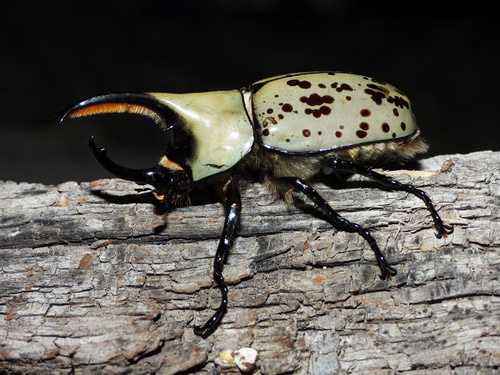
About Dynastes grantii Horn, 1870
Dynastes grantii was first described by Horn in 1870. For adults of both sexes, body length measured from the apex of the elytra to the apex of the thoracic horn ranges from 3.5 to 6.0 cm (1.4–2.4 in). Captive-reared individuals can grow as large as 8.0 cm (3.1 in). The elytra of this species range in color from white to grayish-white, and often bear irregular black spots that vary in size and number. When humidity is high, the elytra may appear black. Dynastes grantii is sexually dimorphic: females do not have the characteristic horns that males possess.
This species occurs in southern Utah, Arizona, and western New Mexico in the United States, as well as in parts of northern Mexico. It typically lives in highland forest habitats at elevations of 1,600 m (5,200 ft) above sea level or higher.
Like other Hercules beetle species, Dynastes grantii has a six-stage life cycle progressing from egg to adult, with three larval instars and one pupal stage. The period from egg to pupal eclosion is estimated to take roughly two years, and the pupal stage itself lasts approximately 30 days. Adults emerge from the pupal chamber between August and October each year. In the wild, adults generally live between two and four months, while captive adults can live up to nine months. After mating, females lay more than 100 eggs.