About Dudleya viscida (S.Watson) Moran
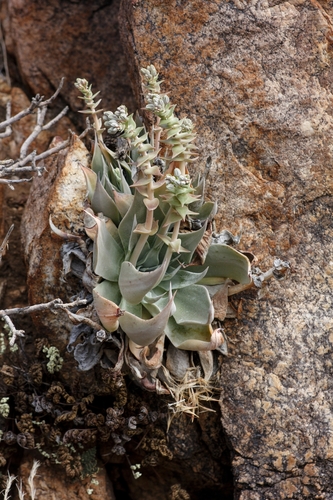
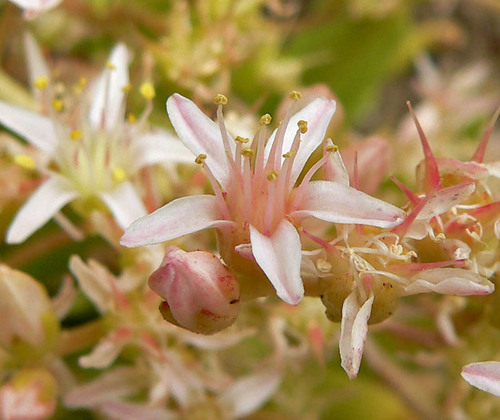
Dudleya viscida forms a basal clump of erect, fleshy, pointed leaves. In cross section, the leaves are nearly cylindrical, but more often elliptical. Their color ranges from pale green to yellow-green or red, and they are covered in a sticky, oily exudate that has a faintly resinous scent. The species produces erect stems that hold many-branched inflorescences; each branch can bear up to 10 flowers. Individual flowers are pink to nearly white, with red veining or streaks, and have protruding stamens between their pointed petals. Flowering occurs from May to June, and the haploid chromosome number for this species is n=17. This Dudleya is endemic to southern California, with only around 20 known occurrences in San Diego, Orange, and Riverside Counties. It grows primarily on bluffs in coastal sage scrub and rocky slopes in inland chaparral, most often at elevations below 450 meters. Within San Diego County, it has been recorded on bluffs at the mouth of the Santa Margarita River, along Escondido Creek at Olivenhain, and along San Marcos Creek.