About Dudleya verityi K.M.Nakai
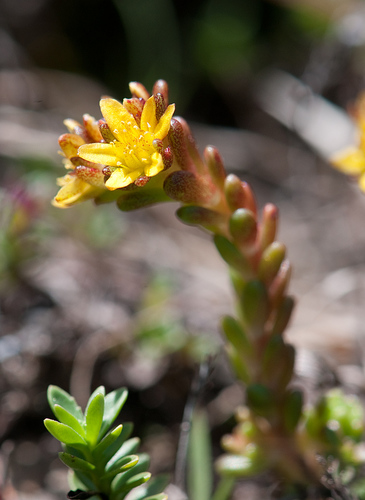
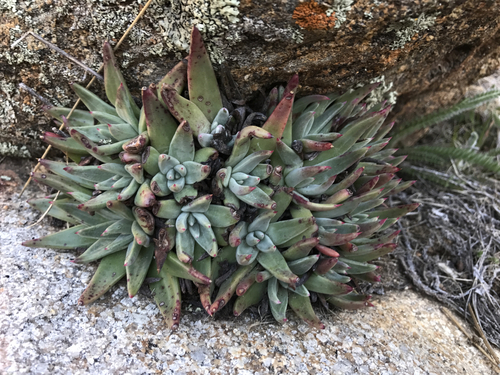
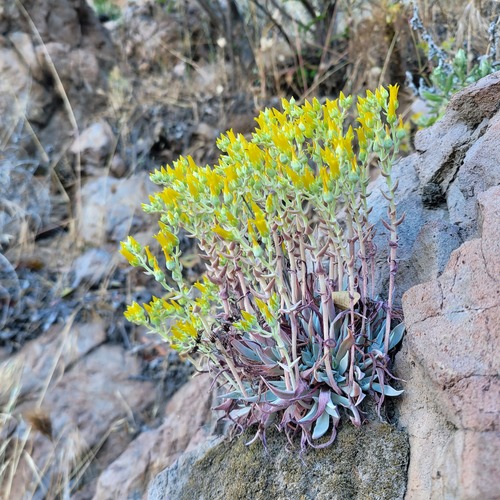
Dudleya verityi K.M.Nakai is a fleshy perennial succulent that grows from a branching caudex several centimeters long. Its leaves form a basal rosette around the caudex, with a waxy texture and pale grayish-green or pinkish-green color. The species produces an erect inflorescence made up of a bract-lined peduncle that reaches up to 15 centimeters tall, which splits into terminal branches each holding several flowers. Each flower has a base of fleshy, triangular sepals and longer bright yellow petals just over a centimeter long.
In detailed morphological terms, the caudex is 2 to 10 millimeters thick and 2 to 10 centimeters long. It branches in a caespitose pattern to form a loose cluster, which can become more tightly compact when grown in cultivation. The full cluster is typically 10 to 40 centimeters wide, and holds 25 to 100 or more individual rosettes. Each rosette is around 2 to 8 centimeters in diameter, with 6 to 10 leaves per rosette. The rosette leaves are glaucous, oblong to lanceolate in shape, with an acute to acuminate leaf apex. Individual leaves measure roughly 2 to 5 centimeters long, 4 to 8 millimeters wide, and 2 to 3 millimeters thick, with a base 5 to 8 millimeters wide. The upper leaf surface is flat to slightly concave, while the lower surface is rounded, and the leaf margins are acute.
The peduncle is glaucous, with purple tinging on its lower third. It is erect, growing 5 to 15 centimeters tall and 3 to 6 millimeters thick, and bears 5 to 15 bracts. The lower 3 centimeters of the peduncle is usually bare of bracts. The bracts are ascending, lanceolate-shaped with an acute tip; the lowermost bracts are 8 to 10 millimeters long and 5 to 7 millimeters wide. The inflorescence branches 2 to 3 times initially, often forming an obpyramidal shape. These primary branches may stay simple (not re-branching) or form bifurcate ascending branches. The terminal branches are circinate, meaning they coil inward like a fern frond when young, and become ascending as they age. Terminal branches grow 2 to 5 centimeters long and hold 2 to 10 flowers each. Pedicels are ascending to erect when the plant is in flower, and become distinctly erect when the plant forms fruit; the lowermost pedicels are 3 to 5 millimeters long and 1 to 2 millimeters thick. The calyx is 5 to 7 millimeters wide and 4 to 5 millimeters high, with triangular segments that are 3 to 5 millimeters long, 2 to 2.5 millimeters wide, and have an acute tip. The corolla is nearly conical in bud, yellow with a green tinge along the midrib, and becomes tubular when open, with a slight constriction at the mouth. The corolla tube is 8 to 10 millimeters long and 4 to 5 millimeters wide at the base, and the petal tips recurve to 90 degrees or more away from vertical. Petals are lemon yellow, oblong to lanceolate in shape, with an acute tip, measuring 10 to 14 millimeters long and 2.5 to 4 millimeters wide at their midpoint, and are connate (fused into a tube) for 1 to 2 millimeters of their length. This species flowers from May to June, and is a diploid with a chromosome number of n = 17.
In its ecology, Dudleya verityi grows in association with mosses and lichens. It often grows within layers of the lichen Niebla ceruchoides, which may form a moisture-trapping bed for seeds that fall from the plant. This species can hybridize with other Dudleya species, including Dudleya blochmaniae. It is only found along one edge of the Santa Monica Mountains, where it grows in coastal sage scrub habitat. The dominant plant species in this habitat are California sagebrush (Artemisia californica), California buckwheat (Eriogonum fasciculatum) and purple sage (Salvia leucophylla). At least two known populations of the species are located within the campus of California State University, Channel Islands.