About Dudleya pulverulenta (Nutt.) Britton & Rose
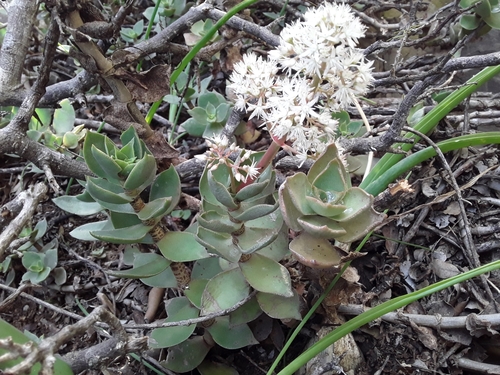
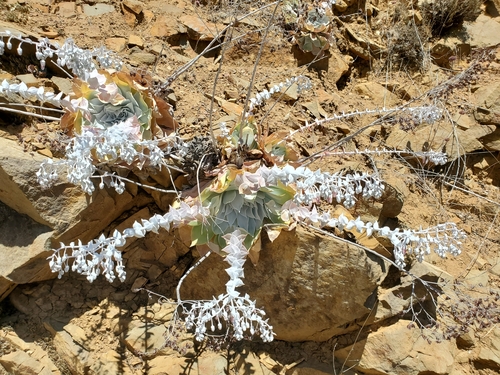
Dudleya pulverulenta is a rosette-forming succulent plant covered in a distinctive chalky, mealy epicuticular wax called farina. It is one of the largest species in the Dudleya genus. Every part of its inflorescence is coated in this chalky wax, and flowering stems can grow up to 150 cm (59 in) long.
This species grows a thick caudex that is 4–10 cm (1.6–3.9 in) wide. As the plant ages, the caudex gradually becomes decumbent, and is densely covered with old, dried leaves. A single solitary rosette grows atop this stem, as stems do not produce axillary branches. Rosettes reach 7–60 cm (2.8–23.6 in) wide, and are made up of 40 to 60 wide, flat, fleshy, chalky white leaves; as leaves age they develop a pinkish papery texture. Leaves are oblong in shape, widest at either the base or upper third, with an acuminate to mucronate or acute tip. They measure 8–25 cm (3.1–9.8 in) long, 3–10 cm (1.2–3.9 in) wide, and 3–10 mm (0.12–0.39 in) thick. The entire plant epidermis is covered with a dense layer of this chalky, powdery epicuticular wax.
The peduncle is 30–100 cm (12–39 in) tall and 5–20 mm (0.20–0.79 in) wide, covered with 20 to 70 bracts. Bracts range from spreading to deflexed in orientation, are shaped cordate-ovate to suborbiculate with an acuminate tip, measure 20–50 mm (0.79–1.97 in) long by 15–30 mm (0.59–1.18 in) wide, and may be reddish in color. The peduncle branches into 2 to 6 branches, which may or may not branch again. There are 2 to 5 terminal branches called cincinni, which are nodding when young and become spreading with age, measuring 10–50 cm (3.9–19.7 in) long. Cincinni are circinate, unfurling like fern fronds. They hold 10 to 30 flowers, and are twisted at the base so that flowers emerge on the underside. Flowers hang pendent from pedicels that are 10–35 mm (0.39–1.38 in) long. As the plant ages, pedicels bend sharply near their middle to move fruits into a more or less erect position.
The calyx measures 5–9 mm (0.20–0.35 in) long by 5–8 mm (0.20–0.31 in) wide, with mostly acute sepals. Petals are 11–19 mm (0.43–0.75 in) long, and are united along 6–10 mm (0.24–0.39 in) of their length. Petal apexes range from acute to obtuse, with erect tips. Sepals are waxy, while petals are red and carry some wax coating. D. pulverulenta flowers in early summer, typically from May to July. Plants growing in full sun close their rosettes during summer; from July to August leaves begin to fold upward and inward, appearing to shrink as temperatures rise. Plants growing on north-facing or shaded slopes are much less likely to close their rosettes.
Dudleya pulverulenta intergrades with both Dudleya anthonyi and Dudleya arizonica, and the boundaries between these three taxa are not always clearly defined. Dudleya brittonii looks superficially similar to this species, but differs notably in having smaller yellowish-white flowers and a dense inflorescence.
Dudleya pulverulenta is native to California and Baja California. Its range extends from extreme southern Monterey County south to Punta Prieta in the central Baja California desert. It typically grows on rocky cliffs and in canyons, usually at elevations below 1000 meters. It is primarily a coastal species, and can often be found within 12 miles of the coast; more inland occurrences are generally found in valleys where heat is moderated by elevation or coastal influence. This species is a very rapid recolonizer, and is known to proliferate on roadcuts and disturbed soil shortly after development. Its preference for rocky, shallow soils and open habitats means there is limited fuel near the plants, allowing it to survive wildfire, and the plant will resprout after fire.
This species has a pollination syndrome uniquely adapted to hummingbirds. It has long red corollas (petal tubes) and unscented flowers. The flowers hang downward (pendent), a shape created by a twist at the base of the terminal inflorescence branches (cincinni) that inverts the flowers from the typical erect or ascending position seen in other Dudleya. Like other hummingbird-adapted plants, pendent flowers let hummingbirds easily reach the flowers from below, while discouraging bees and other insect pollinators from landing easily. After flowering, pedicels make a sharp turn to hold fruits erect. This pollination syndrome is only shared by two other close relatives of D. pulverulenta in the genus: Dudleya anthonyi and Dudleya arizonica. D. arizonica is similar in appearance, and matches D. pulverulenta in many traits, but most populations do not have downward-pointing flowers or the unique fruiting behavior, instead bearing erect flowers and having a generally reduced overall size. Dudleya rigida, another hummingbird-specialized Dudleya found in far southern Baja California Sur, also has long, red, unscented pendent flowers, but the pendent shape comes from different orientations of inflorescence structures compared to D. pulverulenta and its relatives. Other Dudleya, such as Dudleya cymosa subsp. pumila and Dudleya lanceolata, have some adaptations to hummingbirds, but do not have the full set of traits for typical hummingbird flowers.
In cultivation, the plant tolerates full sun or part shade. It is susceptible to aphid infestations that cause deformities to flowers and rosettes. It is a much hardier garden plant than the more commonly available Dudleya brittonii. D. pulverulenta is not known for long life in cultivation, and may only live 2 to 3 years when grown in gardens, but some wild specimens can live over 40 years in the most optimal locations. When the plant dies, the rosette becomes withered and ashy gray, resembling a bird's nest. When checking if the plant is alive, it is important to check if the center rosette leaves are still living, because dormant plants often surround a few live leaves with a ring of withered leaves until the next growing season pushes the dead leaves downward.