About Dudleya multicaulis (Rose) Moran
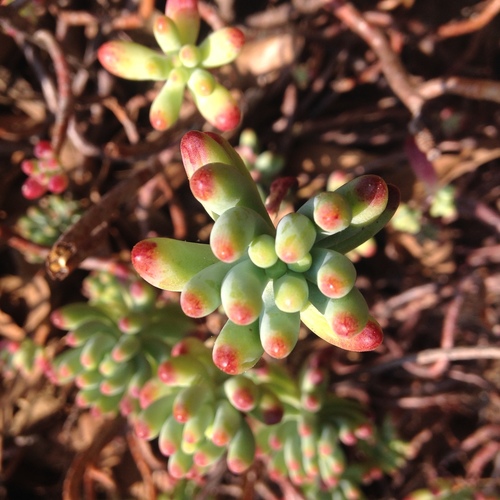
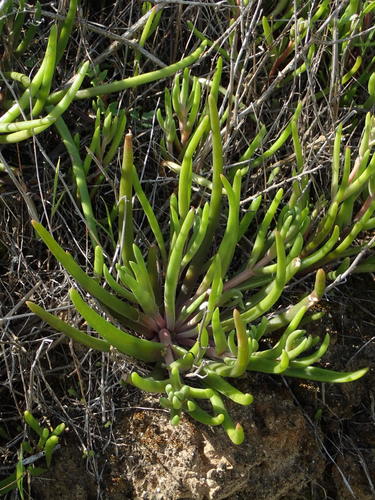
Dudleya multicaulis (Rose) Moran is considered the most basal member of the Dudleya subgenus Hasseanthus, a group characterized by paedomorphic adaptations including vernal foliage and an underground tuberous caudex—traits also seen in Dudleya seedlings. In this species, the caudex is reduced to a subterranean, corm-like structure. The corm is oblong in shape, measuring 1.5–5 cm (0.59–1.97 in) long by 3–18 mm (0.12–0.71 in) wide. Its leaves are arranged in 1 to 4 rosettes that are 2–6 cm (0.79–2.36 in) wide, with 5 to 15 green, summer-deciduous leaves that are non-glaucous or somewhat glaucous. Leaves are cylindrical and linear in shape except at their base; when detached or damaged at the base, the base turns purple-red. Leaves measure 4–15 cm (1.6–5.9 in) long by 2–6 mm (0.079–0.236 in) wide, with a 4–10 mm (0.16–0.39 in) wide base, and a sharply acute leaf tip. The inflorescence grows on a peduncle 4–23 cm (1.6–9.1 in) high and 2–4 mm (0.079–0.157 in) wide, with 7 to 18 strongly ascending bracts that share a similar linear shape with the rosette leaves. The inflorescence first branches 2 or more times, and may rebranch 0 to 1 additional time after this initial branching. The terminal branches, called cincinni, are 2–10 cm (0.79–3.94 in) long, and bear 3 to 15 flowers held on pedicels 0.5–3 mm (0.020–0.118 in) long. The flowers have no odor. Petals are fused (connate) for 1–2 mm (0.039–0.079 in), spreading from near the middle of the petal. They are colored bright yellow to pale yellow that fades, and often have red lines along the keel. Petals are elliptic-lanceolate shaped, 5–9 mm (0.20–0.35 in) long by 2–3 mm (0.079–0.118 in) wide, with an acute apex. Sepals are 2–3 mm (0.079–0.118 in) long and deltate-acute shaped. The open corolla has a diameter of 12–18 mm (0.47–0.71 in). Pistils are connate for 1–2 mm (0.039–0.079 in) and ascending. Ovaries are 3.5–6 mm (0.14–0.24 in) long, while styles are 1.5–2 mm (0.059–0.079 in) long. This species flowers in late spring, from May to June. Dudleya multicaulis is endemic to the Los Angeles coastal plain, adjacent hills, parts of the Transverse and Peninsular ranges, extending south into northern San Diego County, California. It occurs in Orange, Los Angeles, Riverside, and San Diego counties, and historically occurred in San Bernardino County. There are 31 confirmed extant occurrences of this species, 41 occurrences of unknown status, and at least 31 or more extirpated occurrences. D. multicaulis grows primarily on heavy soils, usually clay, as well as on rocky hillsides and sandstone outcrops. The species is declining due to urbanization of its native habitat.