About Dudleya lanceolata (Nutt.) Britton & Rose
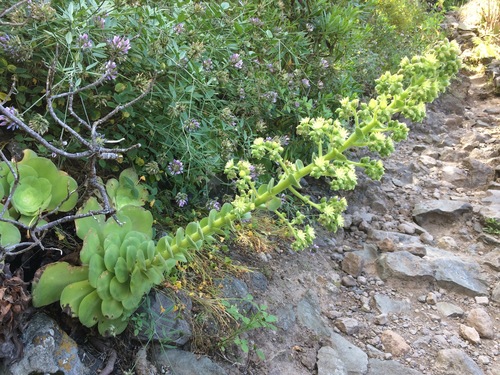
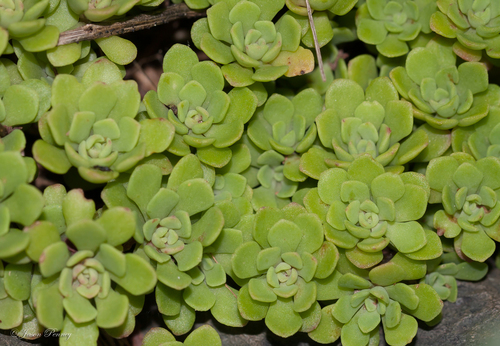
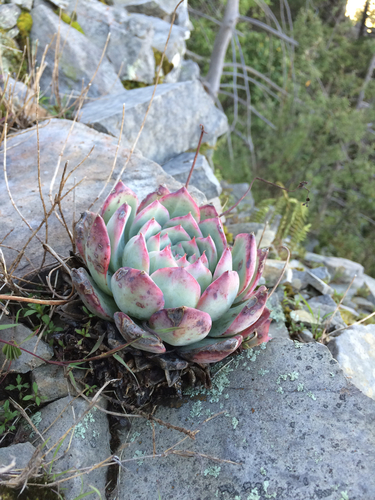
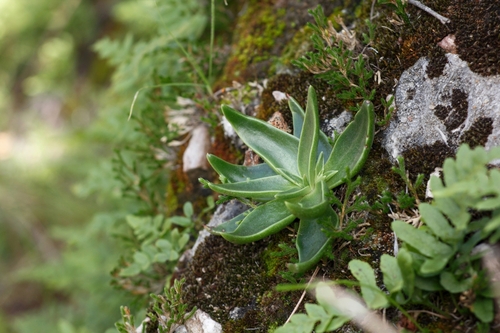
This species, Dudleya lanceolata (Nutt.) Britton & Rose, is a rosette-forming succulent. Rosettes grow from the apex of a caudex, which may be solitary or apically branched, and bears between 1 and 7 rosettes. The caudex measures 1 to 3 cm wide, and is generally less than 4 cm long, though it may occasionally become elongated. The rosettes are 3 to 25 cm in diameter, and typically hold 10 to 25 leaves. The leaves are green, sometimes glaucous, and never farinose. They are shaped oblong to lanceolate, 4 to 30 cm long, 0.5 to 4 cm wide, and 1.5 to 6 mm thick, with an acute tip. For reproductive morphology, the peduncle grows 15 to 95 cm tall and 3 to 12 mm wide. Lower internodes are spaced more than 5 mm apart. The peduncle bears 18 to 40 bracts, which range from spreading to ascending in orientation, and are shaped triangular-lanceolate to ovate. The cyme branches 2 to 3 times, and secondary branches may bifurcate. Terminal branches are 2 to 25 cm long, and hold 2 to 20 flowers on spreading pedicels. The pedicels are 2 to 12 mm long, become erect as they mature, and are colored red or green, usually not pink. Sepals measure 3 to 6 mm, and are shaped deltate-ovate. Petals are 10 to 16 mm long, 3.5 to 5 mm wide, shaped elliptic to oblanceolate, and fused connately for 1 to 2 mm. Petals are most often red or orange, less commonly bright yellow to purplish-red, and very rarely green. Most plants are tetraploid, with a chromosome count of 2n = 68 or n = 34, though occasional octoploid individuals occur. Diploid plants found in montane regions are actually classified as Dudleya cymosa. This species flowers from April to July. It is widely distributed, ranging from Monterey County and Kern County in California, through coastal Southern California, and into Mexico, where its southern limit lies near Ensenada, Baja California at Punta Banda. It also grows on the Coronado Islands. It is not particularly cold-hardy, and typically occurs in areas with moderately high humidity, along the coast and in north-facing inland locations. Dudleya lanceolata is cultivated as an ornamental plant by specialty nurseries, and is used in rock gardens, as a potted plant, and as a native species for natural landscaping.