About Dudleya ingens Rose
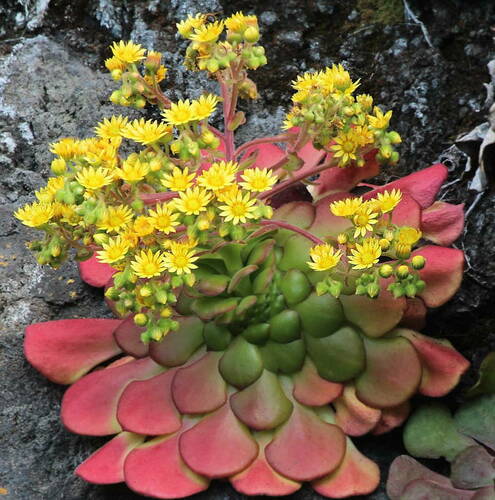
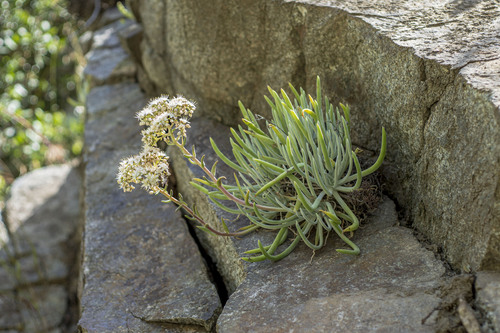
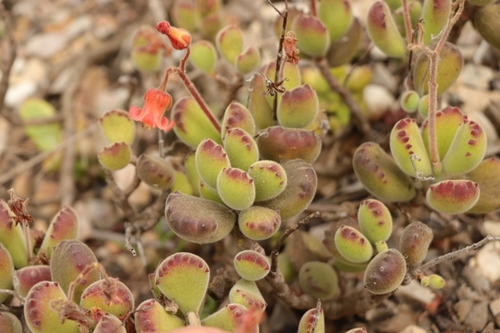
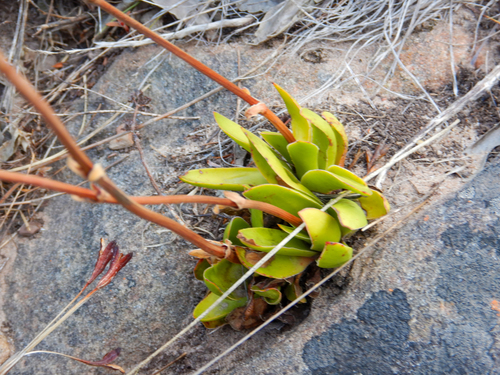
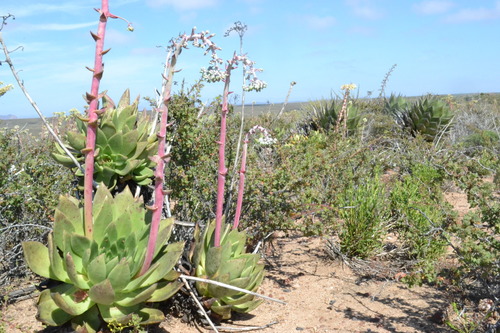
Dudleya ingens Rose is a member of the subgenus Dudleya. This species forms a basal rosette of evergreen leaves, and its flowers have tight petals that form a tube. Its caudex, the main stem, is densely covered with old leathery leaves, and branches very rarely. The rosette of vegetative leaves sits atop the caudex, holding up to 70 leaves that are green or slightly glaucous. The floral stem is reddish and tall, bearing up to 30 bracts. The inflorescence nods when immature, and its terminal branches unfurl like fern fronds. Terminal branches hold up to 20 flowers, with petals ranging from pale yellow to white. In terms of morphology, the caudex measures 1.5 to 6 cm thick, may be short or elongate to 40 cm long, and is either unbranched or branches only a few times. Rosettes are 5 to 40 cm in diameter, and contain 20 to 70 leaves. The leaves are green or slightly glaucous, oblong in shape, tapering from the base or somewhat broadened in the upper third. They measure 7 to 25 cm long, 1 to 5.5 cm wide, and 3 to 11 mm thick, with acute margins toward the base; the leaf base is 1.5 to 6 cm wide and 1 to 3 mm high. Dried old leaves are thick and leathery, and densely clothe the caudex. Floral stems are reddish, 30 to 90 cm tall, 4 to 15 mm thick, hold 10 to 30 bracts, and are leafless on the lower 10 to 30 cm of their base. Cauline leaves are held mostly horizontal to ascending, triangular in shape with an acute tip; the lowermost are 1 to 4 cm long and 7 to 20 mm wide. The inflorescence is sometimes nodding when immature, often glaucous, 5 to 20 cm wide, with 3 to 4 primary branches that rebranch 0 to 2 times. The terminal branches, called cincinni, are circinate, meaning they unfurl like fern fronds, and become ascending when mature; they measure 4 to 15 cm long and hold 10 to 20 flowers, with up to 30 flowers in extreme cases. Pedicels are erect or ascending when flowering, and remain erect when fruiting; the lowermost pedicels are 5 to 15 mm long. The calyx is 4.5 to 6 mm wide and 6 to 7 mm high, and is sub-truncate to tapering at its base. Calyx segments are triangular, with acute to sub-acuminate tips, and measure 4 to 6 mm long by 2 to 3 mm wide. Petals are pale yellow to white, often tinged with pink, oblong with an acute tip, 10 to 15 mm long by 2 to 3 mm wide, and joined for 3 to 6 mm of their length. Reid Moran's 1951 definition of this species includes a wide range of plants with quite diverse appearances. Coastal forms of this species are relatively large, with 30 to 70 rosette leaves reaching up to 25 cm long and 5.5 cm wide, and flowers with petals that are most often yellowish. The inland form, found on the foothills and western slope of the local Peninsular Ranges, is smaller, with 20 to 40 rosette leaves reaching up to 15 cm long and 2 cm wide. A gradual transition between coastal and inland forms can be seen in areas like Arroyo San Telmo and Arroyo Seco. The large coastal form is very similar to Dudleya brittonii. The two species can be separated by the following traits: D. ingens has a lower maximum number of rosette leaves, generally narrower leaves, and leaves that are green to slightly glaucous rather than green to chalky and farinose. D. ingens also has a less dense inflorescence with fewer main branches and longer terminal branches, larger flowers, and petal color that ranges from yellowish to white or pink. Compared to D. brittonii, which is a diploid with a chromosome count of n=17 matching the genus's base chromosome number, most D. ingens are tetraploid with a chromosome count of n=34. Dudleya ingens occurs primarily along the coast and foothills of northwestern Baja California, ranging from the vicinity of Santo Tomás and San Vicente south to Puerto Faro San José. It grows from the coastal plain inland as far as the western slope of the Sierra de San Pedro Martir, with the inland form having a noticeably different appearance but intermediate plants occurring between the two forms. Plants vary in appearance between localities, and plants near Punta Colonet approach the appearance of Dudleya brittonii. This species is suitable for use as a plant in rock gardens or container gardens. It grows well in full sun in well-drained soil with very infrequent summer irrigation. It is cold hardy to 25 °F (−4 °C) and drought tolerant. Its leaves are evergreen, and reddish stems bearing pale yellow to white flowers emerge from spring to early summer. Leaves may be green or covered with red spots.