About Dudleya hendrixii S.Mc Cabe & Dodero
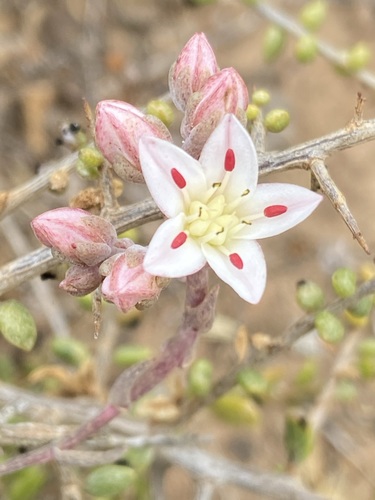
Dudleya hendrixii is classified in the Dudleya subgenus Hasseanthus, a group of species defined by small drought-deciduous leaves, flowers with widely spreading petals, and a tuberous underground stem that resembles a corm. Researchers have proposed that the corm-like stem and small drought-deciduous leaves are paedomorphic adaptations, as these traits appear in young Dudleya seedlings but are not typically retained into maturity in species from other subgenera. Among species in the Hasseanthus subgenus, D. hendrixii is set apart by its unique combination of odorless white flowers, a globose-spherical underground stem, and 3 to 5 linear to spindle-shaped leaves that grow from narrow petioles. D. hendrixii also shares notable morphological similarities with Dudleya attenuata, a non-deciduous species in the subgenus Stylophyllum: both have narrow, grey-white leaves with acute tips, and D. attenuata subsp. orcuttii additionally shares the trait of small white flowers. Morphologically, D. hendrixii is a low-growing, rosette-forming succulent that reaches 5 cm (2.0 in) across. It is mostly acaulescent, with the apex of the stem sitting flush with ground level. The rest of the stem forms a corm-like underground structure that is spherical to slightly longer than it is wide. The stem does not branch, so plants form solitary rosettes with 3 to 5 leaves. The leaves are summer-deciduous, typically have a light gray glaucescent appearance, and are shaped linear to fusiform. They may grow straight or curved, ending in an acuminate to attenuate tip, and attach to narrow, upright petioles. The leaves are oriented upright, their outer ends are usually spaced far apart, and one leaf typically curves over the apex of the plant. Plants usually produce 2 to 4 inflorescences. Peduncles grow from the stem, are 1–2 mm (0.039–0.079 in) thick, and develop into an inflorescence that reaches 10–20 cm (3.9–7.9 in) tall. The peduncle is lined with succulent bracts; the lower bracts measure 4–10 mm (0.16–0.39 in) long by 3–7 mm (0.12–0.28 in) wide and have an attenuate tip. The lowermost two bracts are positioned nearly opposite each other, while all bracts above them are mostly alternate. Several short terminal branches 1–2.5 cm (0.39–0.98 in) long hold the flowers. Flowers are borne on pedicels up to 1 mm (0.039 in) long. The calyx is roughly 3 mm (0.12 in) long, has red-brown sepals, is more or less glaucous, and becomes particularly glaucous near its base. Petals are pink when in bud; when mature, they are white with pink on the lower surface and marked with red stripes along the keel. Petals measure about 8 mm (0.31 in) long by 3 mm (0.12 in) wide, and are united for approximately 1 mm (0.039 in) or less of their total length. Anthers have red tips before dehiscence and produce yellow pollen. Carpels are spreading, and become widely spreading as they mature into follicles. Due to its very limited small habitat, D. hendrixii is under threat of extinction from grazing and land development.