About Dudleya greenei Rose
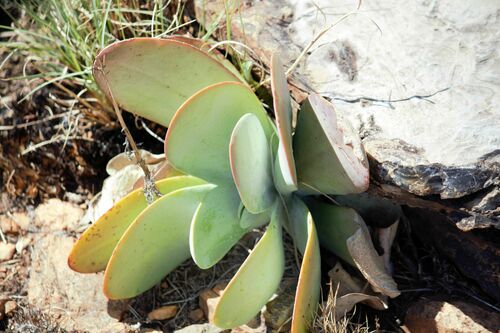
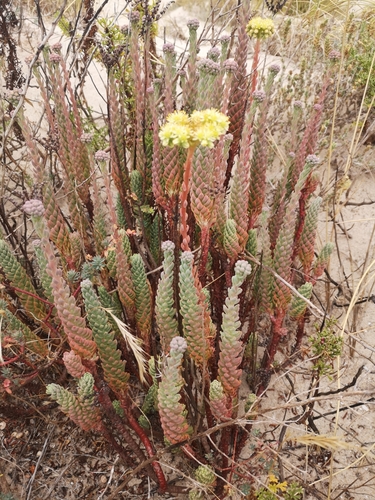
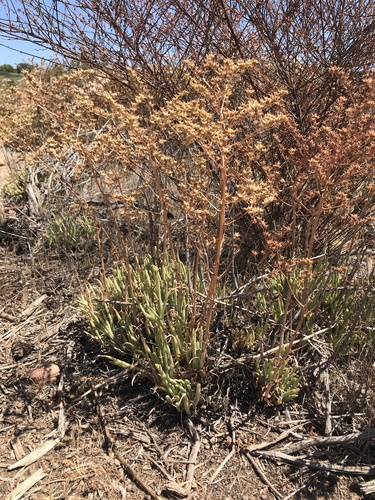
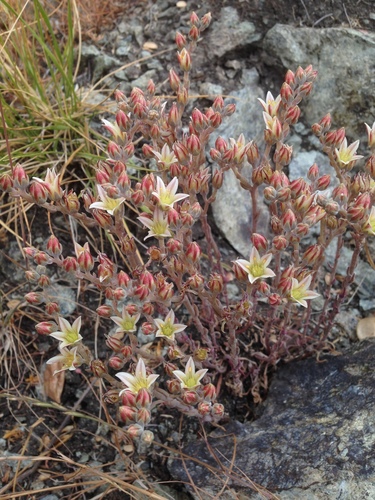
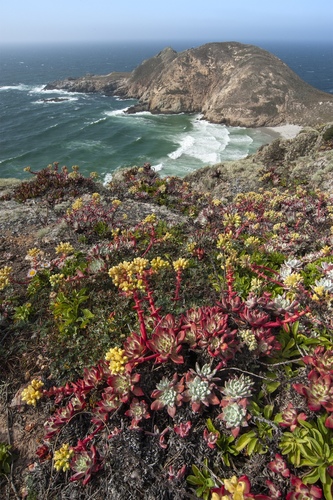
Dudleya greenei Rose can be caespitose or non-caespitose, and may form clumps up to 1 meter wide. It can produce anywhere from 1 to over 100 rosettes, with each rosette 5 to 46 cm wide. The caudex is 2 to 5 cm wide, may grow elongated, and unlike that of the closely related D. candelabrum, it does not become swollen at the base. Its leaves are evergreen, measuring 3 to 22 cm long, 1 to 3.5 cm wide, and 4 to 8 mm thick. Leaf shape is variable; leaves may be covered in white epicuticular wax, or may appear green. The leaf base is generally 1 to 3 cm wide, and typically turns red or yellow when the leaf is detached from the stem. The leaf tip is usually acute, and leaf margins typically have 0 to 1 angles between the upper and lower leaf surfaces. The peduncle is 4.5 to 50 cm tall and 3 to 5 mm wide. The inflorescence typically has 3 first-degree branches, which may rebranch 0 to 2 additional times. The terminal branches are 1 to 9 cm long, and each bears 2 to 15 flowers. Bracts measure 10 to 30 mm long and 5 to 12 mm wide, are shaped lanceolate to oblong, and are more or less thick; they are not reflexed (bent backwards). Pedicels are 1 to 5 mm long. The flower has deltate sepals 1.5 to 5 mm long. Petals are 8 to 12 mm long, 3 to 5 mm wide, and are connate (fused into a tubular corolla) for 1.5 to 2.5 mm. Petals are elliptic in shape, have an acute apex, and are colored pale yellow to more or less white, especially white along the margins. Pistils are connivent and erect. This species flowers from May to July. This Dudleya is distributed across the northern Channel Islands of California, growing on Santa Cruz, San Miguel, and Santa Rosa islands, but not on Anacapa, where the present species is instead D. caespitosa. It occurs on coastal cliffs and rock outcrops. Tetraploid individuals of this species are also found on Catalina Island. Some campanulate-flowered plants on Catalina may be hybrids between Dudleya greenei and Dudleya virens subsp. insularis.