About Dudleya edulis (Nutt.) Moran
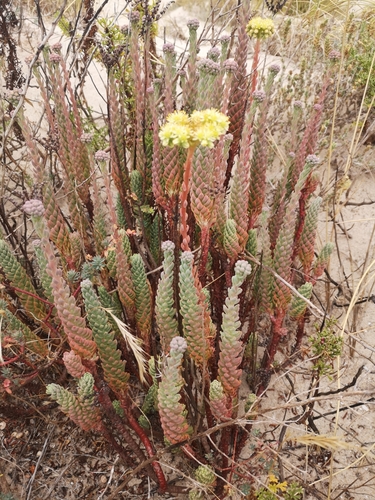
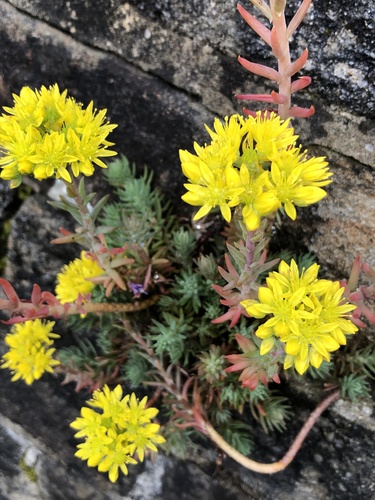
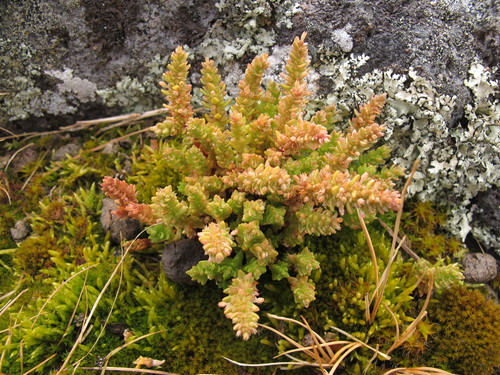
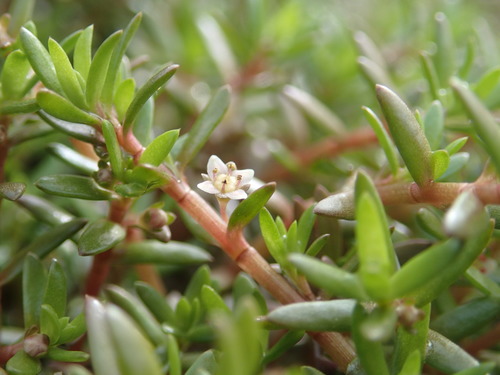
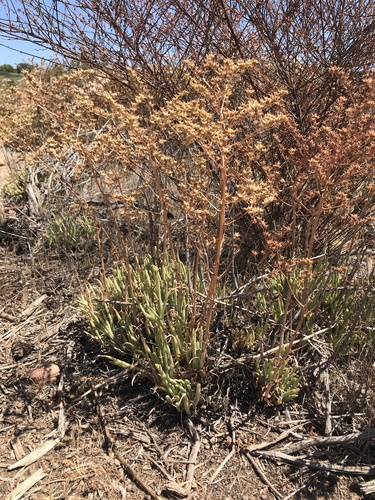
Dudleya edulis (Nutt.) Moran produces a cluster of fleshy, finger-shaped leaves that grow vertically from a caudex located at or just below the ground surface. The pale green leaves are cylindrical and pointed, and can reach up to 20 centimetres (7.9 in) in height. It produces a branching inflorescence that grows 10–50 centimetres (3.9–19.7 in) tall, with several terminal branches each holding up to 10 or 11 flowers. Its flowers have pointed white to cream petals approximately one centimeter long. This species blooms from May to July. It is a diploid plant with a chromosome number of n=17, the base chromosome number for the genus Dudleya. This species is endemic to chaparral areas, along extensive sandstone ocean cliffs and coastal canyons that extend from Southern California in the United States south into northwestern Baja California, Mexico. In California, it occurs in coastal Orange County, extends east through southern Riverside County, and continues south through San Diego County. It ranges roughly 40 miles inland from the ocean, and can be found at elevations up to around 4,200 feet (approximately 1300 m) above sea level in some locations. Its range extends south into the Rio San Vicente drainage in Baja California, a region that spans over 190 miles (305 km) inland from the Pacific coast, east toward the southwest flank of Cuyamaca Peak, the second-highest peak in San Diego County. Within its southern distribution, the species grows primarily on north-facing slopes and cliffs, rather than west-facing maritime exposures. It grows on rocky slopes, in rocky soil, on rock outcrops, and on ledges, at elevations ranging from sea level to below 1,300 metres (4,300 ft). It can be found in coastal sage scrub, chaparral, and woodland habitats. Dudleya edulis is cultivated as an ornamental plant. It is used in native plant gardens, wildlife gardens, drought-tolerant rock gardens, and grown as a potted specimen plant. Thomas Nuttall recorded that Indigenous people of the region used this plant as a food source, which is the origin of its specific epithet edulis. Native peoples harvested the young tender leaves in spring to eat them raw. Tiipai members of the Kumeyaay have a specific name for narrow-leaved Dudleya like this species: milh kajmila.