About Dudleya cespitosa (Haw.) Britton & Rose
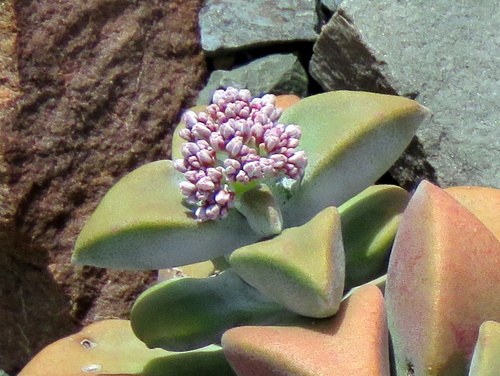
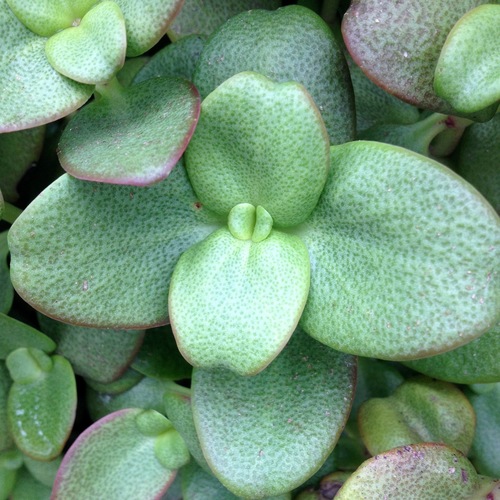
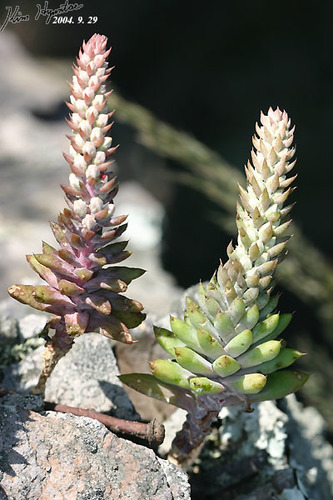
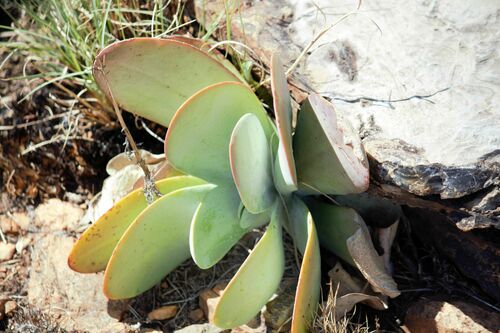
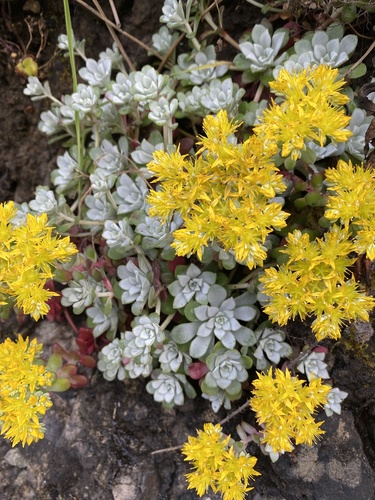
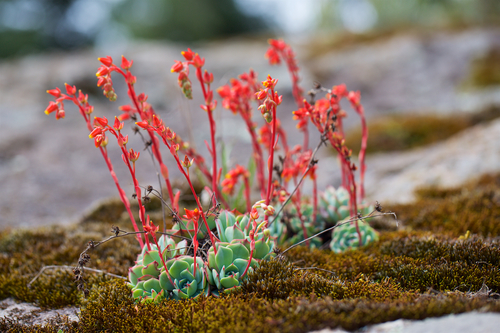
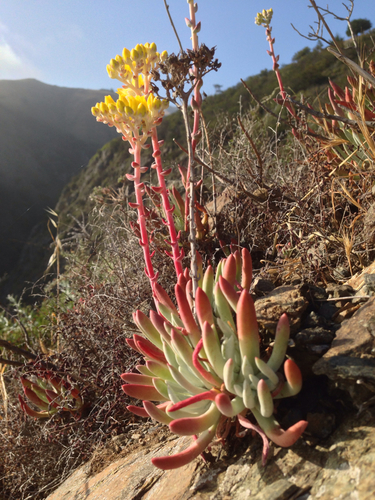
Dudleya cespitosa, formally named (Haw.) Britton & Rose, shows distinct variation in its vegetative morphology. Plants may grow as solitary rosettes, but most frequently form loose caespitose clumps that can hold more than 150 rosettes. Individual rosettes are 8 to 32 cm wide, and contain 15 to 30 leaves each. The caudex measures 1.5 to 4 cm wide, and is often exposed between dry leaves on older specimens. Unlike Dudleya candelabrum, the stem is not swollen at its base, and it has a longer stem than Dudleya farinosa, caused by longer spaces between its internodes. Leaf shape is extremely variable, but is most often lance-oblong, or oblong to oblanceolate, with leaf tips that are generally acute to sub-acuminate. Leaf margins typically do not form an angle between the upper and lower leaf surfaces. Leaves are generally 5 to 20 cm long, 1 to 2 cm wide, 3 to 8 mm thick, and their bases measure 0.5 to 4 cm wide. In terms of reproductive morphology, the peduncle is typically 10 to 60 cm tall and 3.5 to 10 mm wide. The inflorescence usually has 3 to 5 first-order branches, which may remain unbranched or branch again up to two times. The branches do not twist, and flowers grow on the upper side of the branches. Each terminal branch is 3 to 15 cm long, and bears 4 to 15 flowers. There are 12 to 25 bracts, which spread to ascending, and are shaped triangular ovate to lanceolate. Pedicels are 1 to 6 mm long, erect, and do not bend when the plant produces fruit. Sepals are 2 to 5 mm long, shaped deltate-ovate with an acute tip. Petals are 8 to 16 mm long, 3 to 5 mm wide, shaped elliptic, and are connate (fused into a tubular corolla, characteristic of the subgenus Dudleya) for 1.5 to 2.5 mm. Petals have an acute apex with erect tips, and are most often colored bright yellow to orange yellow or red. This species is common along the coast of California, but its exact biogeographical distribution is difficult to define, as species delimitation for this taxon relies on arbitrary characteristics. The 2012 Jepson Treatment places the northern limit of the species at the southern North Coast of the California Floristic Province, with plants identified as Dudleya caespitosa found from Point Reyes in the north southward to Malibu. On California's central coast near Santa Maria, where multiple oil refineries emit phytotoxic sulfur dioxide, Dudleya caespitosa proved to be somewhat tolerant of these emissions even when other plants such as Salvia mellifera (black sage) were negatively affected. This tolerance is likely a result of the species using CAM photosynthesis, which causes its stomata to open during evening hours. Combined with nighttime southeast winds that blow refinery emissions away from the area, this combination of CAM photosynthesis and local meteorological conditions helps the plants avoid exposure to the phytotoxic fumes.