About Dudleya candelabrum Rose
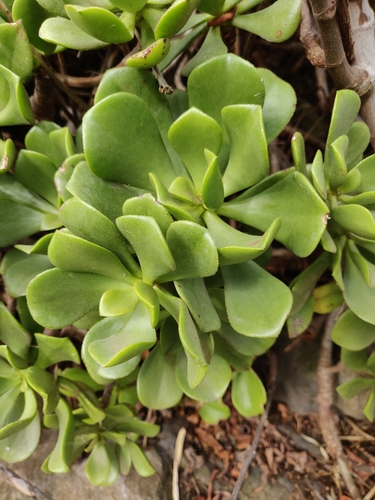
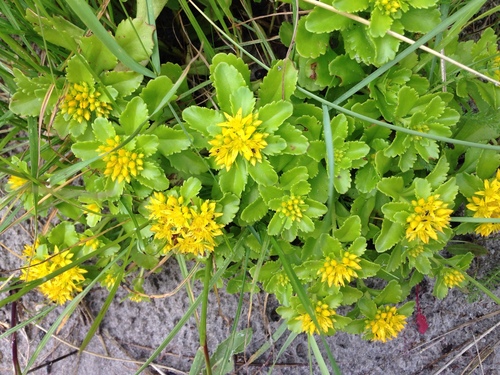
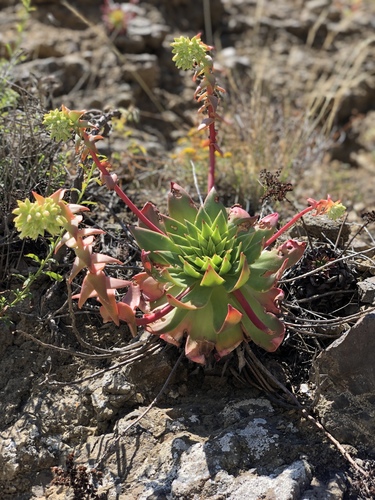
Dudleya candelabrum Rose is a succulent plant species that typically grows from an often solitary basal rosette, which reaches up to half a meter across, sitting atop a thick, hardy caudex that is swollen at its base. The rosette bears 20 to 45 evergreen leaves. These leaves range in color from pale green to pinkish-green, are shaped obovate to oblong-oblanceolate, and are more or less thin in texture. Leaves may be glaucous, and when torn away from the rosette, they leave a purple-red wound. Each leaf measures 6 to 22 centimeters (2.4 to 8.7 inches) long by 3 to 7 centimeters (1.2 to 2.8 inches) wide, and ends in an acuminate tip. The unbranched peduncle is generally erect, but often bends under the weight of the inflorescence it supports. The peduncle is usually 15 to 54 centimeters (5.9 to 21.3 inches) tall and only 6 to 11 millimeters (0.24 to 0.43 inches) wide. The bracts are long and reflexed, bending backwards. The lowermost bracts are 1 to 4 centimeters (0.39 to 1.57 inches) long. The inflorescence first branches 3 to 7 times, and these branches then branch another 1 to 2 times. The terminal branches are 2.5 to 13 centimeters (0.98 to 5.12 inches) long and hold up to 25 flowers. Each flower has pale-yellow petals 8 to 12 millimeters (0.31 to 0.47 inches) long, held within pink-tinged green sepals. Flowering occurs from May to July, and the species has a chromosome number of 17. Botanist Reid Moran noted that this plant resembles the green form of Dudleya brittonii, but phylogenetic analysis has shown it is actually related to Dudleya acuminata — a geographically distant species that also shares the trait of shiny green leaves. Despite the species' characteristic green leaves, some individuals may instead have white, glaucous leaves, which makes them hard to distinguish from the polymorphic Dudleya greenei. The two can be separated by the fact that D. candelabrum grows in steep, inland to coastal canyons, often on north-facing or shaded cliffs, or in deeper soils than D. greenei, and D. candelabrum has long, reflexed bracts. Dudleya candelabrum is endemic to Santa Cruz Island and Santa Rosa Island, where it grows on rocky, north-facing slopes below 1,200 feet.