About Dudleya attenuata (S.Watson) Moran
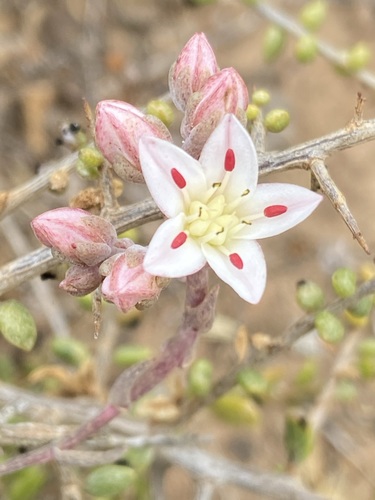
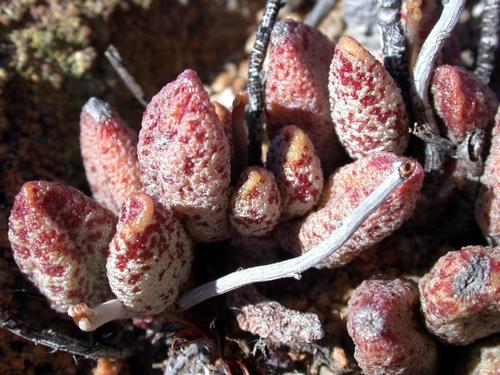
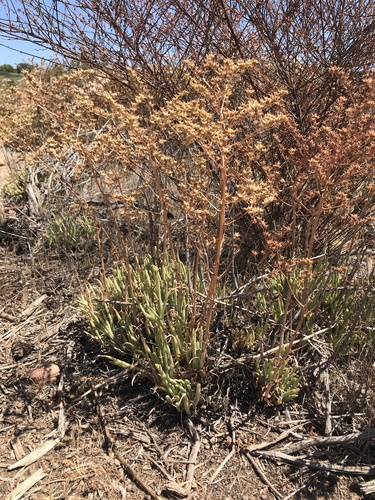
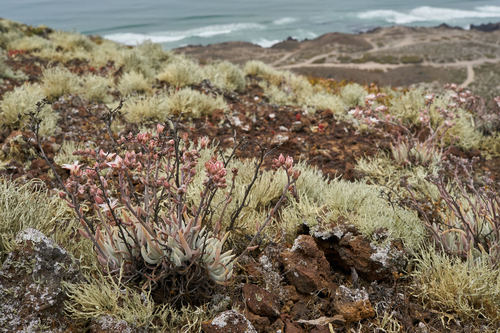
Dudleya attenuata is a highly diverse and polymorphic species, so the description below is a generalization of its common features; refer to the taxonomy section for morphology descriptions of each individual subspecies. Its caudex ranges from erect to sprawling, measures 3 to 15 mm thick, can grow 30 cm long or longer, branches to form clumps 10 to 40 cm wide, and is often covered in dried leaves. Rosettes are 2 to 5 cm wide, and each holds 5 to 20 erect leaves. The leaves are farinose, shaped linear to linear-oblanceolate, have an acute tip, and are terete; they measure 2 to 10 cm long and 2 to 5 mm wide. The leaf base is lenticular, suborbicular, or oval, 5 to 15 mm wide and 2 to 4 mm high, and is sometimes taller than it is wide. Peduncles are 5 to 30 cm tall and 1 to 3 mm thick, and remain leafy from the base up to 1 to 4 cm below the tip. The stem bears 5 to 15 ascending bracts, shaped linear-lanceolate to deltate-ovate with an acute tip; the lowest bracts measure 0.5 to 8 cm long and 2 to 5 mm wide. Higher up the inflorescence, it is made up of 1 to 3 simple branches 2 to 15 cm long, which hold 3 to 15 erect flowers attached to pedicels 0.5 to 3 mm long. On each flower, the calyx is 3 to 6 mm wide and 2 to 5 mm high, divided into deltate-ovate sepals with acute tips that measure 1.5 to 4 mm long and 1 to 2 mm wide. The corolla is cream, white, or pinkish, with the keel finely marked in red. Petals measure 5 to 11 mm long and 1.5 to 4 mm wide. For the stamens, filaments are 3.5 to 11 mm long, and anthers are red to yellow and 1 to 2 mm long. Seeds are reddish brown and 0.7 to 1 mm long. Plants are diploid, typically with a chromosome number of n = 17. D. attenuata is nearly endemic to Baja California, with the only exception being a population located north of the Mexico-United States border in San Diego County, California, at Border Field State Park. It also occurs offshore on the Coronado Islands and Isla Todos Santos. It can be found growing on coastal bluffs, usually at elevations below 165 ft.