About Dudleya anomala (Davidson) Moran
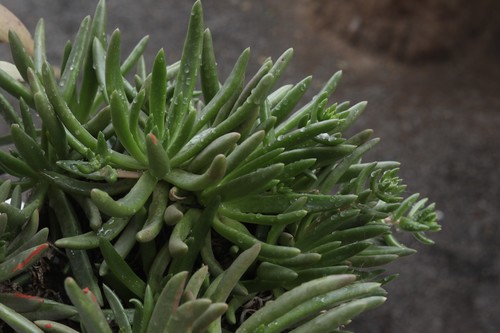
Dudleya anomala (Davidson) Moran is a rosette-forming leaf succulent with a caespitose growth habit. Stems branch to form dense cushions of rosettes, reaching 3–4 decimeters (12–16 inches) in total diameter. Stems are elongated, procumbent, up to 3 decimeters (12 inches) long and typically 5–10 millimeters (0.20–0.39 inches) thick. Rosettes form at the tips of stems, holding 20 to 30 closely arranged leaves that may spread apart when stems grow rapidly. Leaves are shaped strap-oblanceolate to strap-shaped with acute tips. The lower leaf surface is convex, while the upper surface is only slightly convex. Leaf margins are obtuse or rounded, except toward the leaf base. Leaves measure 2–5 centimeters (0.79–1.97 inches) long and 4–6 millimeters (0.16–0.24 inches) wide, with leaf bases 4–7 millimeters (0.16–0.28 inches) broad, and are slightly viscid (sticky).
The flowering peduncle measures 5–15 centimeters (2.0–5.9 inches) long and 1–3 millimeters (0.039–0.118 inches) thick, and is covered in ascending bracts. Bracts are shaped narrowly deltoid-ovate to deltoid-lanceolate with sharply acute tips; lower bracts measure 1–2 centimeters (0.39–0.79 inches) long by 3–5 millimeters (0.12–0.20 inches) wide. The inflorescence is compact, overall rounded, and about 3–4 centimeters (1.2–1.6 inches) in diameter. It typically has three main branches that may or may not branch once again, with terminal branches holding 3 to 5 flowers on pedicels 2–5 millimeters (0.079–0.197 inches) long.
On each flower, sepals are deltoid to deltoid-ovate with acute tips, measuring 2–2.5 millimeters (0.079–0.098 inches) long. Petals are somewhat spreading from the base, with outward-curving tips. They are narrowly ovate with acute tips, measuring 8–10 millimeters (0.31–0.39 inches) long by 3.5–4 millimeters (0.14–0.16 inches) wide, and are connate for 0.5 millimeters (0.020 inches) or less. Petals are white, with small red flecks along the keel. Stamens measure about 5–6 millimeters (0.20–0.24 inches) long, and are adnate to the petals for 0.5–1.5 millimeters (0.020–0.059 inches). Anthers are orange and 1.5 millimeters (0.059 inches) long. Carpels are 6–7 millimeters (0.24–0.28 inches) long and connate for about 1 millimeter (0.039 inches), spread apart as they mature, and have styles 2 millimeters (0.079 inches) long.
Dudleya anomala has sticky, odorous foliage, a trait only shared by Dudleya viscida. Compared to D. viscida, D. anomala has smaller leaves, thinner caudices, and smaller, simpler inflorescences.
Dudleya anomala is found only in Baja California, Mexico, with an insular distribution on the Islas Coronados and Isla Todos Santos, plus one mainland location at the extreme tip of Punta Banda. Its range overlaps with the ranges of Dudleya lanceolata, Dudleya candida, and Dudleya attenuata. Specimens observed by Reid Moran grew on steep, north-facing cliffs on the Coronado Islands. On Isla Todos Santos, this species grows as dense cover over rocks and cliffs on northern and eastern exposures. At Punta Banda, it occurs on steep, north-facing beach cliffs that overlook Todos Santos Bay. Populations of Dudleya anomala are consistently associated with the lichen Niebla ceruchoides.