About Dudleya albiflora Rose
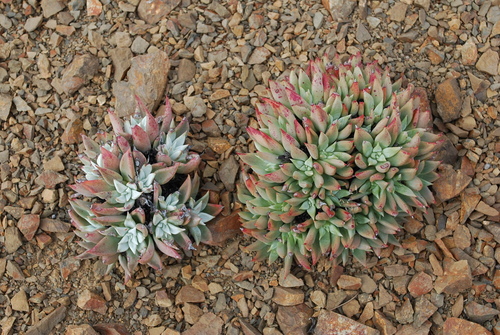
Dudleya albiflora Rose is a rosette-forming perennial succulent that shows a wide range of form variation depending on where it grows. Joseph Nelson Rose's original description of this species is based on the type specimen collected at Magdalena Bay, Baja California Sur. In this form, plants clump together to form groups of 25 or more rosettes. The leaves are narrow, ranging from strap-shaped to lanceolate, and measure 1 to 1.5 cm wide and 4 to 5 cm long. They have a distinctive flattened, yet thick and fleshy structure. The leaves are not glaucous, and turn purplish towards their tips. The corolla is white. Plants from the Magdalena Bay population have a chromosome number of 85. Plants growing on Isla Espiritu Santo and Isla Partida, east of La Paz, have a chromosome number of 34 and narrower white leaves. A former separate species, Dudleya moranii (common name Moran dudleya), which was described from specimens collected at Miller's Landing, Baja California, is now treated as a synonym of D. albiflora, though it has different chromosome counts than plants from D. albiflora's type locality. This synonymized form is solitary when young, and eventually divides in twos to form up to 8 rosettes. It has a caudex that grows 5.1 cm (2 in) to 13 cm (5 in) long. Basal leaves spread evenly, with lower leaves growing decurrent. The leaves are linear-attenuate, with abruptly short-acuminate or cuspidate tips, and measure 8 to 10 cm long and 1.5 to 2 cm wide at the base. Their color is light greenish-yellow, with light red coloration at the tips of the leaf bases. The leaves are stiff, solid, and brittle. Flowering stems grow from the axils of maturing leaves. The sepals are glossy green with red tips. The corolla is pure opaque white, with slightly spreading tips. Most mainland and Cedros Island plants of this form have a chromosome number of 51, while plants from Isla Natividad and Punta San Pablo have a chromosome number of 68. Dudleya albiflora is distributed along the desolate southern Baja California coast, extending south to the islands of Espiritu Santo and Isla Partida off La Paz. It grows in a variety of widely separated coastal locations, as well as some inland locations. It is also found on the Pacific islands of Cedros Island and Isla Natividad. Plants related to this species occur far inland in the Sierra de San Francisco.