About Dryocosmus kuriphilus Yasumatsu, 1951
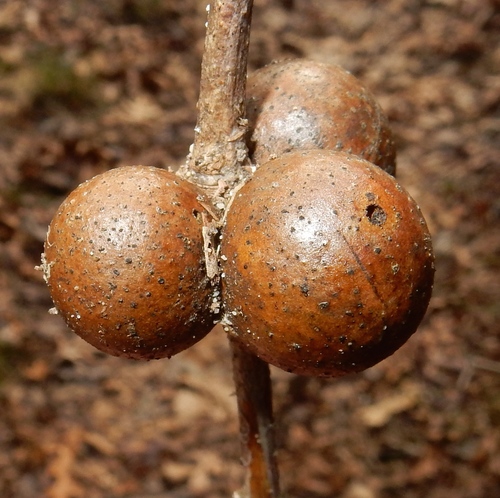
Dryocosmus kuriphilus, a species of gall wasp, has the common names chestnut gall wasp, Oriental chestnut gall wasp, and Asian chestnut gall wasp. It is native to China, and is an introduced invasive horticultural pest in many other parts of the world, particularly the Northern Hemisphere. It attacks many species of chestnut (genus Castanea), including most cultivated varieties, and is considered the world's worst pest of chestnuts. When it was first discovered, this wasp was classified as a species of Biorhiza. It was formally described and given its current scientific name in 1951, by which time it had already invaded Japan and was attacking chestnuts there. Today it can also be found in Korea, Nepal, Italy, Slovenia, France, Switzerland, other parts of Europe including Flanders (Belgium), and the southeastern United States. Adult female wasps are 2.5 to 3 millimeters long, shiny black with brown legs. They produce stalked white eggs around 0.2 millimeters long; the larva is white and reaches roughly 2.5 millimeters long. No adult males of this species have ever been observed. This species is thelytokous: females produce fertile eggs via parthenogenesis, without fertilization by a male. Females lay eggs in chestnut tree buds, sometimes laying more than 100 eggs per individual. Oviposition takes place in summer. Larvae hatch but do not start growing immediately; growth begins the next spring when the tree's buds start to develop. At this point, the larvae induce the tree to form galls, which are green or pinkish and up to 2 centimeters wide. Larvae develop inside these protective galls, then emerge as adults. After emergence, the galls dry out and become woody. The galls cause significant damage to chestnut trees. They form on new tree growth, disrupt fruiting, and can reduce a tree's yield by up to 70%. They are also known to kill trees. While the wasp can fly, it most often spreads to new areas via human activity, such as planting new trees or transporting infested wood. Gall formation also increases a tree's chance of contracting chestnut blight, a disease caused by the fungus Cryphonectria parasitica: the open gall left after the mature wasp departs provides an entry point for the fungus to infect the tree's tissues. Galls may also become infected by Gnomoniopsis smithogilvyi, a pathogen that affects sweet chestnuts. Chestnut species affected by this gall wasp include Japanese chestnut (Castanea crenata), American chestnut (C. dentata), Chinese chestnut (C. mollissima), European chestnut (C. sativa), Seguin chestnut (C. seguinii), Henry's chinquapin (C. henryi), and chestnut hybrids. It has not been observed infecting Allegheny chinquapin (C. pumila). Common control measures are pruning infested buds off trees and protecting buds with netting. These methods are not practical for large stands of trees, such as commercial chestnut orchards. In China, where labor costs are lower, Castanea seguinii (Chinese chinquapin) is used as a trap crop. When a hedge of C. seguinii is planted around C. mollissima (Chinese chestnut) orchards, wasps encounter and attack the buds of the less valuable C. seguinii first, allowing the galled twigs to be cut off and destroyed. Pesticides are generally not effective against this pest, because the wasps develop inside the protective galls. One successful control method is the introduction of the torymid wasp Torymus sinensis, a parasitoid used for biological pest control against the gall wasp in Japan. Research is ongoing to determine where else it is appropriate to release this parasitoid. A number of other parasitoid species have been recorded attacking the chestnut gall wasp, including the torymids Torymus beneficus, T. geranii, and Megastigmus nipponicus, the ormyrid wasps Ormyris punctiger and O. flavitibialis, and the eurytomid wasps Eurytoma brunniventris and E. setigera. These species are not effective as control agents, because their parasitism rates are too low.