About Drymornis bridgesii (Eyton, 1850)
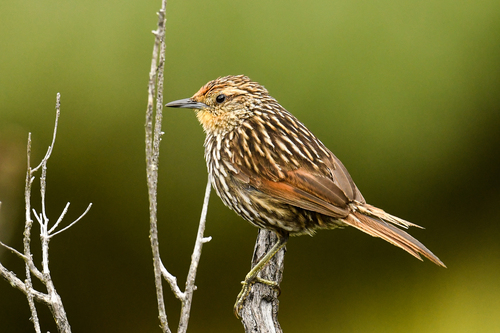
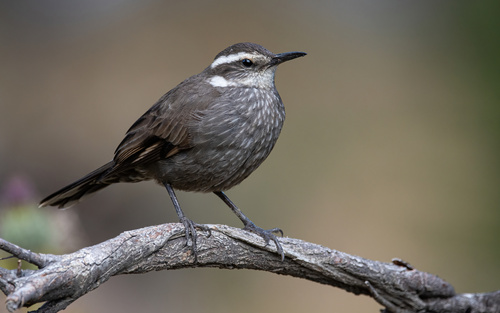
The scimitar-billed woodcreeper, Drymornis bridgesii (Eyton, 1850), measures 26 to 35 cm (10 to 14 in) in length and weighs 76 to 110 g (2.7 to 3.9 oz). It is a large woodcreeper with a relatively short tail and a long decurved bill. The sexes share identical plumage. Adults have dark rufous ear coverts, plus a white supercilium and white moustachial stripe. Their forehead, crown, and nape range from rufous to dark brown; the nape is slightly lighter with white flecks. Their back, scapulars, and most wing coverts are cinnamon-brown to reddish brown. Their rump, uppertail coverts, and tail are rufous. Their greater primary coverts and flight feathers are darker brown than the back. Their throat is white. Their underparts are reddish brown marked with bold white streaks that narrow as they extend through the belly to the undertail coverts, and these streaks have dark brown edges. Their iris can be yellowish, light grayish brown, or dark brown; their bill is brownish or black with a pinkish base on the mandible; their legs and feet are horn-colored, gray, or dull black. Juveniles have dark and light chestnut streaks on the neck, and their underpart streaks are less well defined than those of adults. The scimitar-billed woodcreeper is distributed across extreme southeastern Bolivia, western Paraguay, the Brazilian state of Rio Grande do Sul, Uruguay, and extends south into north-central Argentina. It inhabits the Gran Chaco, Pampas, and Argentine Espinal ecoregions, where it occurs in woodlands, scrublands, thorn forest, and savanna. It can also be found in abandoned pastures and fragmented woodlands within agricultural areas. In most of its range, it occurs up to an elevation of 500 m (1,600 ft), though in some parts of Argentina it can reach 1,350 m (4,400 ft).