About Drymocallis fissa (Nutt.) Rydb.
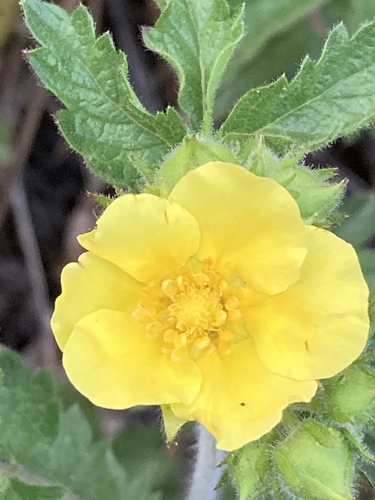
This species, Drymocallis fissa, grows numerous stems from the top of a single rootstalk attached to a branched, persistent woody caudex. Its leaves are pinnate, bearing 7 to 13 slightly hairy leaflets. The edges of these leaflets are cut into small points. Stems are hairy and reddish. Most often, each stem produces a cyme of multiple flowers that grows taller than the plant’s basal leaves. Plants typically reach 15 to 35 cm in height, though they may occasionally grow as short as 12 cm or as tall as 45 cm. Drymocallis fissa ranges from northern New Mexico in the United States north to Alberta, Canada. It is most common in the Front Range mountains and lower foothills of Colorado, and in Wyoming’s Medicine Bow Mountains. It has also been reliably recorded in the Black Hills of South Dakota. The USDA notes observations from San Miguel County, New Mexico; Carbon County, Montana; Stillwater County, Montana; Custer County, Idaho; plus Oregon and Utah, but these observations are suspected to be misidentifications of other species. Bigflower cinquefoil, the common name for this species, is a perennial plant. It frequently grows in mixed woodland lower foothill habitats, alongside sagebrush, on rocky slopes, and in open meadows at higher elevations. It occurs at altitudes between 1600 and 3000 meters. It favors disturbed, rocky areas with more moisture, but does not grow in waterlogged soils. In 1994, NatureServe evaluated Drymocallis fissa as globally apparently secure (G4). This global ranking means the species faces a fairly low risk of extinction or population collapse, thanks to its extensive range and/or large number of populations, though there is some possible cause for concern. It has additionally been ranked vulnerable (S3) at the state level in Wyoming.