About Drymocallis arguta (Pursh) Rydb.
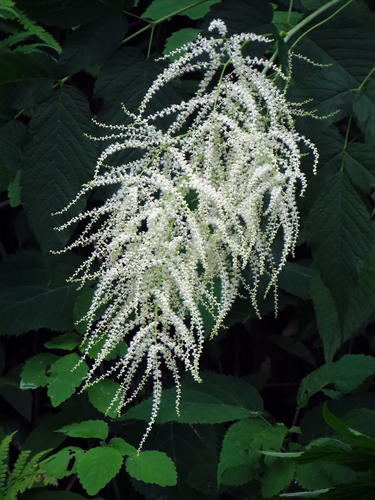
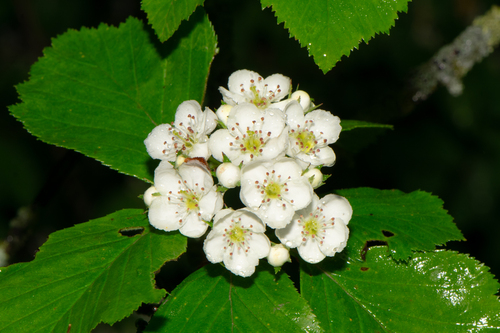
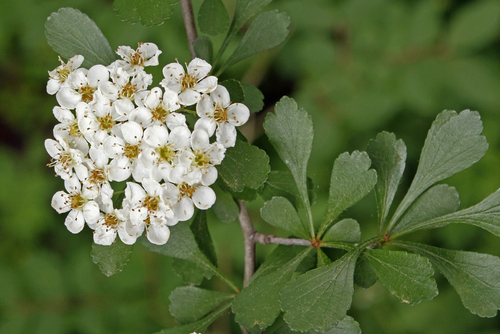
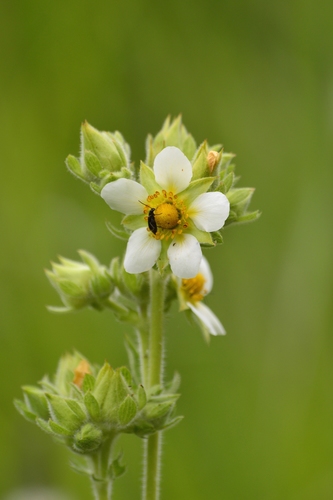
This species, Drymocallis arguta (Pursh) Rydb., produces pinnately compound leaves with an uneven number of leaflets, most frequently between 7 and 11 leaflets per leaf. Most of its leaves grow in a rosette at the base of the plant, while a smaller number of leaves are arranged alternately along the flowering stem. All leaves are densely covered in short, somewhat sticky hairs called trichomes. Its flowers grow in a tight cluster called a cyme, borne on a long stem that reaches 12–40 inches (30–100 cm) in height. The flowers resemble strawberry flowers, with five white or cream-colored petals, five pointed green sepals positioned between the petals, a round central head of pistils, and a ring of more than 20 stamens surrounding the pistil head. Nectar is secreted from a ring located below the pistils. Because the flowers are small, both nectar and pollen are easily accessible to short-tongued insects. Small short-tongued bees visit the flowers to collect or feed on pollen and nectar, hoverflies feed on the pollen, and wasps occasionally feed on the nectar. After pollination, the pistils develop into a head of many small brown seeds, enclosed in a cup formed by the dried sepals. The plant has a taproot root system with short rhizomes at the soil surface, which let it grow into tight clumps. Drymocallis arguta is thought to be a protocarnivorous plant. In a 1999 experiment, several plants growing in the Pacific Northwest were tested for traits of the carnivorous syndrome. The experiment used protein digestion as a diagnostic test to identify plants that produce protease enzymes capable of breaking down captured potential prey. D. arguta showed an ability to digest and absorb 14C-labeled algal protein that had been placed on its sticky trichomes. To date, it remains unknown whether the digestive enzymes come from the plant itself or from microbes living on the plant's surface.