About Drosera stenopetala Hook.f.
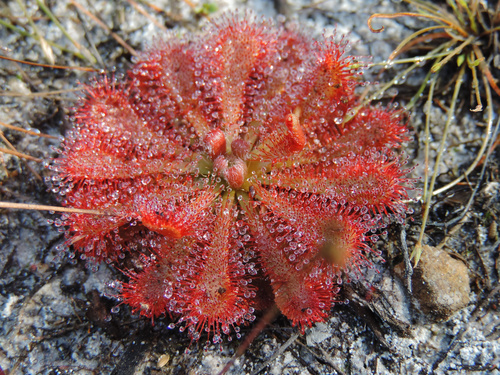
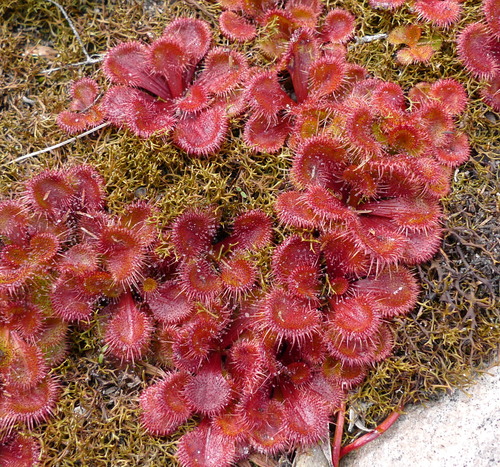
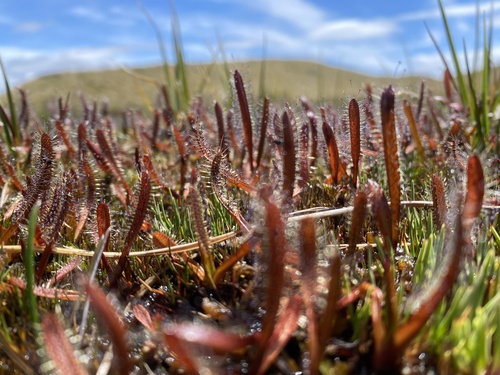
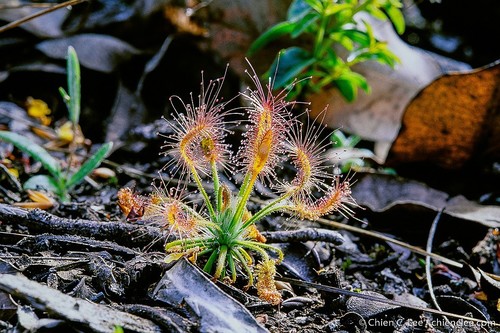
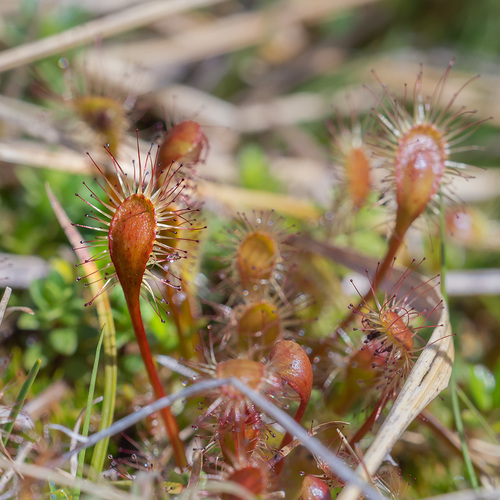
Drosera stenopetala Hook.f. is winter-dormant, growing from an underground rhizome. Its leaf shape changes throughout the growing season: it emerges as a flattened rosette of around 10 short leaves with broad leaf stalks, which then become more raised. Closer to its flowering season, the plant produces much more erect leaves with narrow, hairless leaf stalks up to 80 mm (3.1 in) long. These leaves are rounded and spoon-shaped, 15 mm (0.59 in) long, and covered in long glandular hairs. As the growing season ends, the leaves become shorter again. Flowering occurs between December and February. A single, solitary, hairless flower stalk up to 20 cm (7.9 in) tall bears one flower. The calyx is five-lobed, smooth, and 3.5 mm (0.14 in) long. Petals can grow up to 10 mm (0.39 in) long; they are narrow at the base, taking on a narrowly wedge-shaped or rounded form. The petals are white, with a yellow-green tinge at the base. The ovary sits above the petal bases; it is large and bears three divided styles. The seed capsule holds small, brown-black seeds that are possibly wind dispersed. Characteristic features of the species include involute (inwardly curved) petioles and upright leaves. The range of Drosera stenopetala extends from the Ruahine and Tararua Ranges in the north, down the Southern Alps to Stewart Island. It is also found on the Auckland Islands and Campbell Island. It is a wetland obligate, patchily distributed in cold environments such as montane to alpine bogs, seepages, or wet rock faces. It can occur at sea level in the colder, southerly parts of its range.