About Drosera glanduligera Lehm.
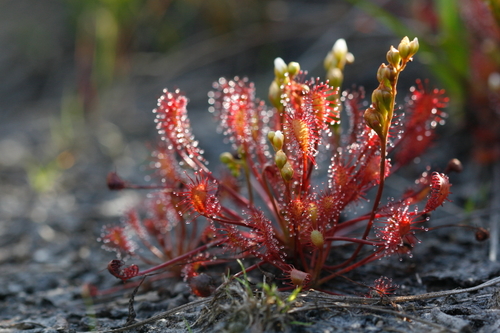
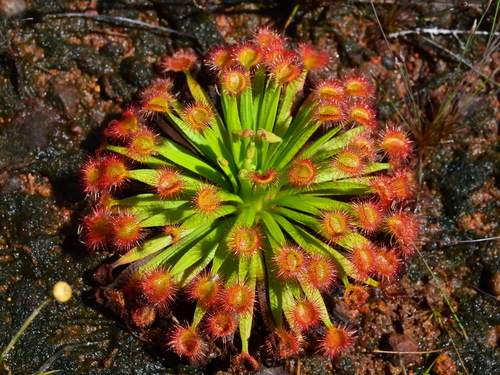
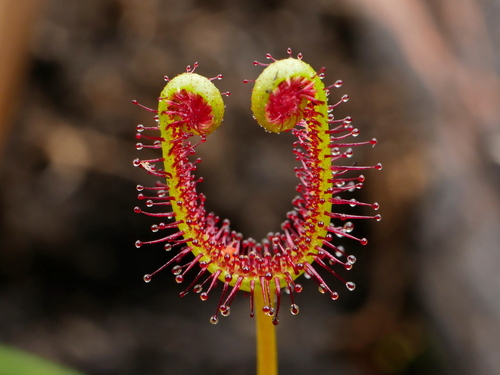
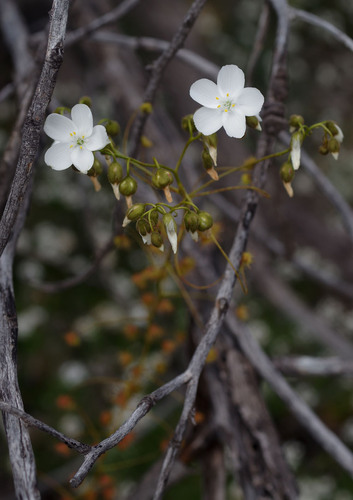
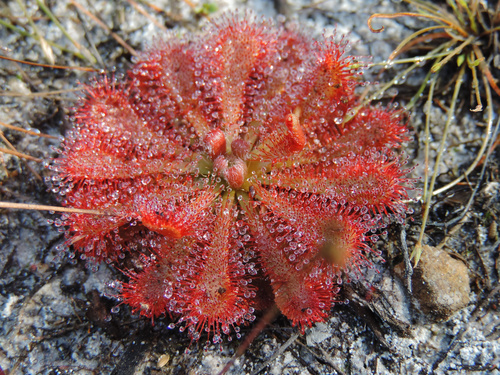
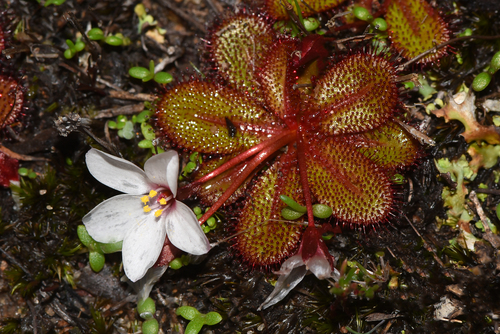
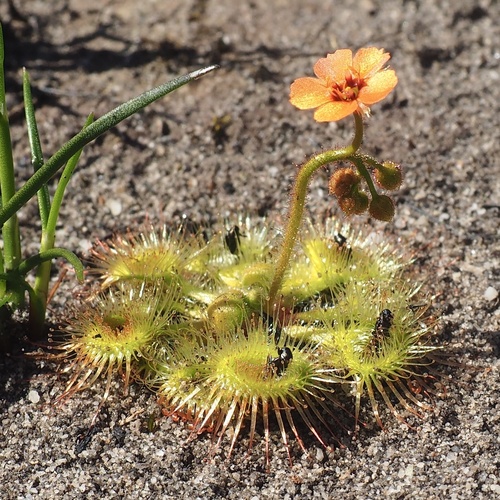
Drosera glanduligera Lehm. is a small herbaceous carnivorous plant that forms a convex to nearly flat rosette. It typically has 15 to 20 concave spathulate leaves, each 8–20 mm (0.31–0.79 in) long. It lacks a tuber and has fibrous roots. When flowering, it produces an erect glandular-hirsute stem up to 10 mm (0.39 in) tall that bears several orange flowers. Every leaf is covered in touch-sensitive glandular tentacles: sticky glue-tentacles grow at the leaf center, while non-sticky snap-tentacles line the leaf margins. This species has a unique trapping mechanism that combines features of both flypaper traps and snap traps. When triggered, the outer snap-tentacles catapult prey onto the sticky central glue-tentacles. The glue-tentacles slowly draw the prey into the leaf's concave depression over approximately 2 minutes, after which digestion begins. Each snap-tentacle can only perform this snapping movement one time, and cannot move again after triggering. Drosera glanduligera is a widespread species native to Australia. It occurs in southern Queensland, New South Wales, South Australia, Victoria, Western Australia, and Tasmania, including Flinders Island. It grows in a wide range of habitats and soil conditions across its range, and can be locally abundant in some areas. This plant can be difficult to cultivate. For germination, seeds require cool night temperatures around 1–8 °C (34–46 °F) and warmer day temperatures of 15–25 °C (59–77 °F). Seed scarification can also help improve germination rates. To support strong growth and blooming, cultivated plants must be kept well fed, either with natural prey or diluted foliar fertiliser.