About Drosera capensis L.
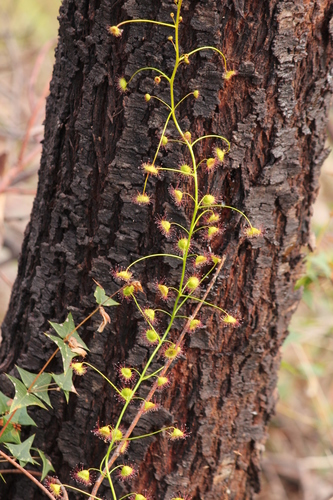
Drosera capensis L. has elongated, roughly rectangular leaves with a distinct petiole that is typically similar in length to the leaf blade (lamina), though some growth forms have a petiole that is significantly longer than the lamina. Its vernation is geniculate-involute: the lamina unfolds first from the petiole, then the lamina margin and tentacles unfurl outward from the leaf axis. In cross-section, the petiole forms a narrow trapezoid with a thickened midrib on its lower (abaxial) side. The petiole is covered in fine, translucent white hairs, which are sparse on the upper (adaxial) surface and sparse to moderate on the lower surface. The lamina is usually slightly wider than the petiole. Long glandular hairs, called 'tentacles', grow along the margins of the lamina's upper surface, surrounding shorter glandular hairs that occupy the center of the upper lamina. The lower surface of the lamina does not have tentacles, but bears a sparse to moderate covering of shorter, white, translucent, spreading hairs. D. capensis has prominent stipules at the base of each leaf; these structures are brown, roughly triangular, and membranous, with an apex that is either intact or slightly divided into setae. They measure 6–8 mm (0.24–0.31 in) long and 4–5 mm (0.16–0.20 in) wide. Like other Drosera species, D. capensis has many different types of glandular trichomes (hairs). In addition to the large prey-capturing 'tentacles', D. capensis leaves have two types of microscopic glandular trichomes: Type 3 trichomes, which are short, unbranched, biseriate, with a two- or three-celled stalk and a vertically divided gland, and Type 10 trichomes, which are unbranched short glandular hairs with a biseriate stalk and a multicellular gland. The native range of D. capensis extends across the full width of the south coast of South Africa's Western Cape province, stretching north from Cape Town to Gifberg and east into the Eastern Cape as far as Port Elizabeth. Confirmed native locations include Brandfontein near Bredasdorp, Elim, Houwhoek, Ceres, the area near the N7 road between Clanwilliam and Citrusdal, the Verlorenvlei River, Hermanus, Paarl, Table Mountain National Park, Diep River near Plumstead, Riversdale (including the Korinte River), Franschhoek, Jonkershoek, Viljoenspas, Tradouw Pass, Tulbagh Kloof, Theewaterskloof, and Bainskloof. It occurs at elevations from 0–1,800 m (0–5,900 ft) in permanently wet habitats including seeps, creek edges, and coastal wetlands, as well as in sheltered locations such as cliff bases. The species grows in peaty or sandy soils, on moss-covered rocks, in quartzite rubble, and in Sphagnum moss beds. At seepage sites, it may grow on near-vertical rock faces. Even though D. capensis is known as a weed in cultivation, it is often uncommon or localised within its native habitat, though it can become locally abundant where competing vegetation is suppressed, such as after a fire. D. capensis is one of the most widely cultivated sundew species. It is a relatively large, showy species whose leaves move dramatically when capturing prey. It is easy to propagate, grows quickly, readily produces attractive flowers, and is widely considered very easy to grow.