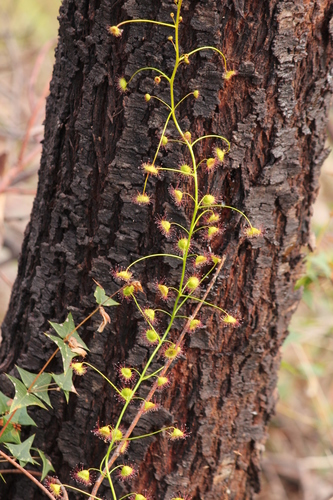
About Drosera arcturi Hook.
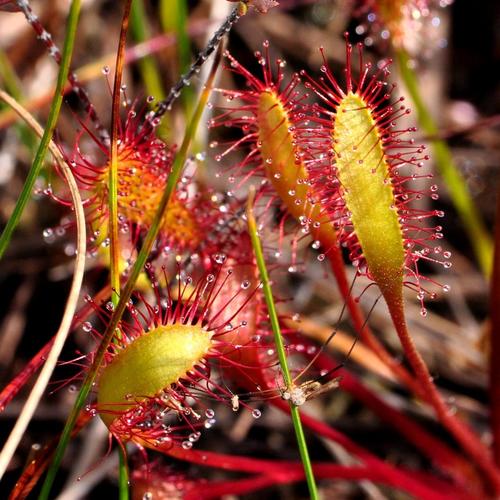
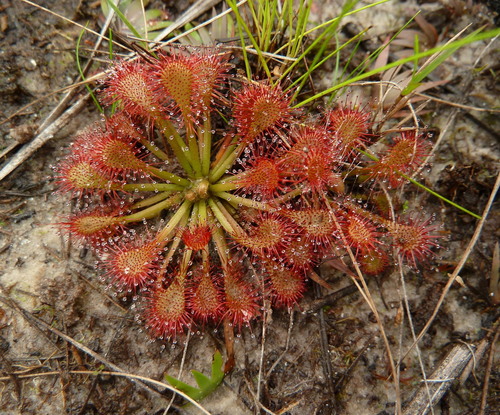
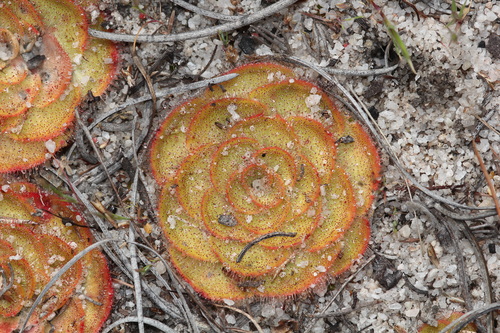
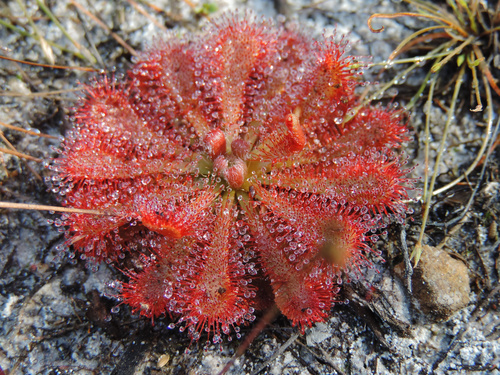
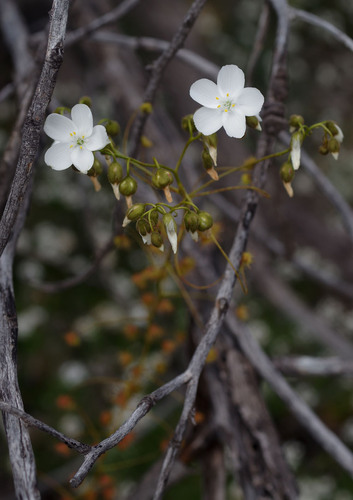
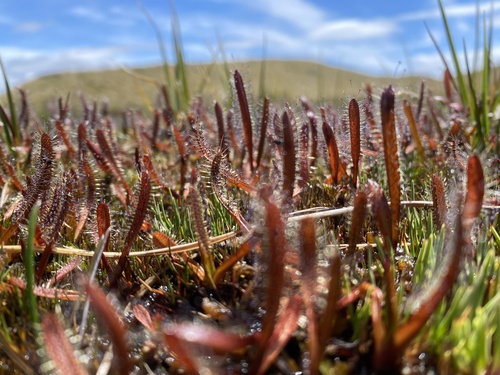
Drosera arcturi Hook. has linear, undivided leaves that measure 1–5 cm long. Leaf color ranges from pale green to muddy brown, and turns maroon when the plant is exposed to full sunlight. Like all other Drosera species, D. arcturi catches insects using sticky, glandular hairs on its leaves; in this species, these glandular hairs are red. New leaves emerge from the center of the plant, folded along their midline, and unfold like a book once they reach full maturity. The plant’s first upright leaves emerge in spring. After two or three leaves develop, the common nominal form produces a single small white flower 13 mm across, which is held on a short stalk near the top of the leaves in summer. The giant lowland form of the species produces 1–5 flowers on a long inflorescence that can grow up to 25 cm long. Flowers appear from November to February, and fruits develop from January to March. D. arcturi is a summer-growing species. After flowering, its leaves gradually shrink in size to form an elongated, horn-shaped hibernaculum, which allows the plant to survive cold, harsh alpine winters. The hibernaculum is typically buried just below the surface of soil or moss, and is usually covered by snow for several months over winter. Drosera arcturi grows in bogs, tarns, and seepages, most often at montane or alpine elevations, and is very common in Sphagnum bogs. It occurs in alpine areas from the East Cape of New Zealand’s North Island, extending south to Stewart Island, New Zealand. In the North Island, it grows above 1,500 m altitude, while it descends to sea level in the South Island. It is also found in the mountains of southeastern Australia and in Tasmania, where it occasionally grows down to sea level in the west and south-west of the island. In New Zealand, D. arcturi often grows in clumps alongside Utricularia dichotoma.