About Drosanthemum lavisii L.Bolus
Taxon Identity
Drosanthemum lavisii L.Bolus is a slender, succulent shrub.
Leaf Dimensions
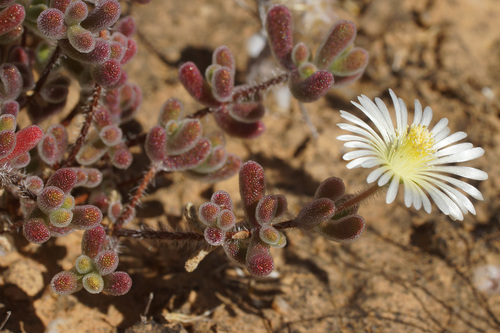
Its leaves are small and slender, measuring 10–14 mm long by 1–3 mm wide.
Leaf Shape
They are often slightly flattened, being a little wider than they are thick, and each leaf has a pointed, downward-curving hook at its tip.
Leaf Surface
Like D. speciosum and D. pulchrum, this species has smooth leaf surfaces.
Flower Color
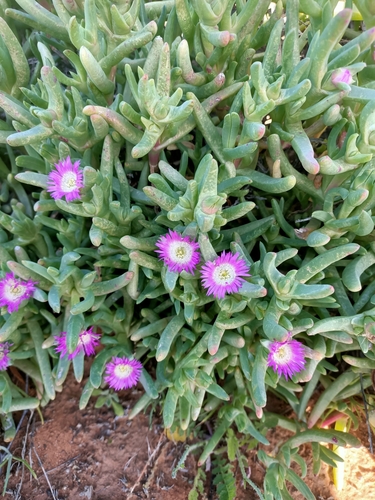
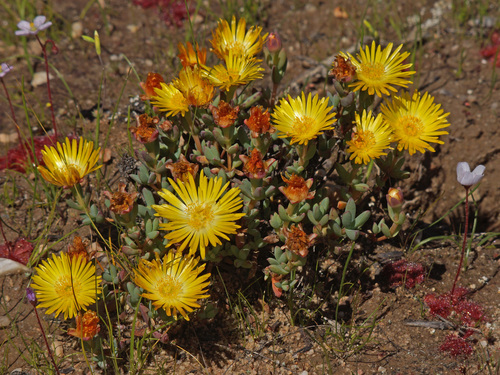
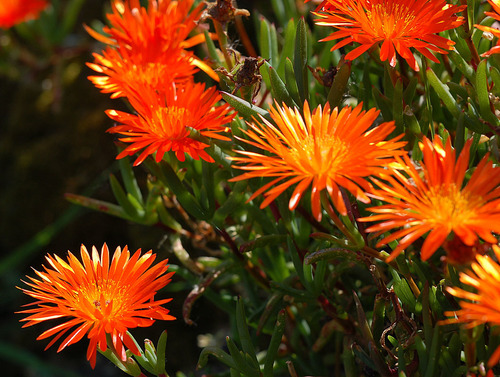
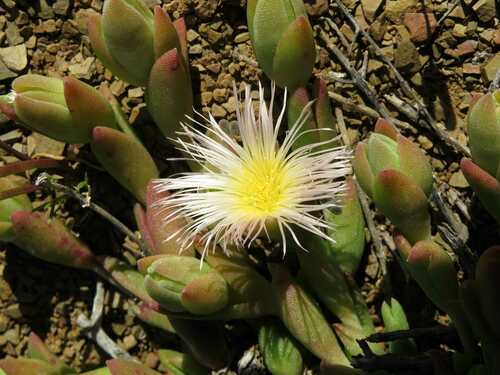
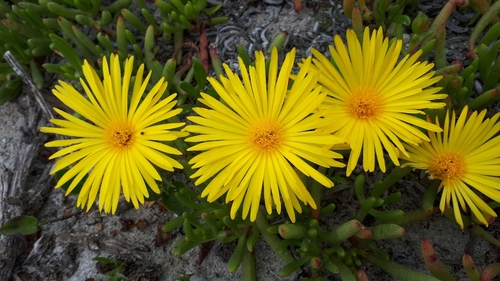
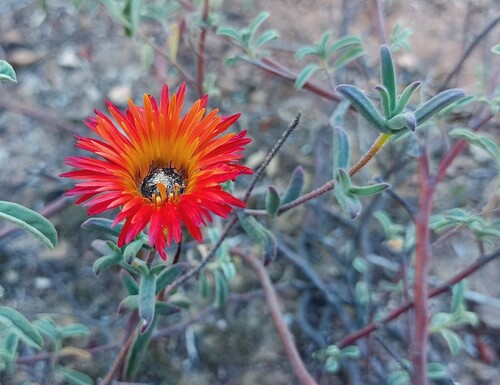
Its flowers can be bright yellow, orange, pink or red.
Diagnostic Leaf Tips
Drosanthemum lavisii can be identified by its recurved, hooked (uncinate) leaf-tips; this trait is especially prominent on new leaves, and is also found in D. edwardsiae and D. uniondalense.
Diagnostic Calyx Trait
It can also be distinguished by the rough base of its calyx, which has 9 to 13 bladder cells along each ridge, a characteristic it shares with D. boerhavii.
Conservation Status and Endemic Range
Drosanthemum lavisii is an endangered species that is endemic to the Western Cape Province of South Africa.
North-South Distribution
Its distribution range stretches from Ashton, Bonnievale and Montagu in the north, south to Bredasdorp and the northern foothills of the Potberg mountain.
Eastward Distribution
Eastward, it grows through the Heidelberg and Riversdale regions of the Overberg, reaching as far as Albertinia.
Vegetation Transition Zone Habitat
It grows along the inland transition zone between the Renosterveld and Fynbos vegetation types.
Preferred Habitat Geology
This species prefers habitats of conglomerates and colluvial terraces with quartzite cobbles.
Substrate and Associated Vegetation Types
Its substrate sometimes also includes silcrete, ferricrete or shales, and it is frequently found in Shale Renostervelds and Ferricrete Fynbos vegetation types.
Microhabitat
It grows in alluvial gravels among surrounding vegetation that includes small shrubs, Restionaceae, and a high density of grasses.