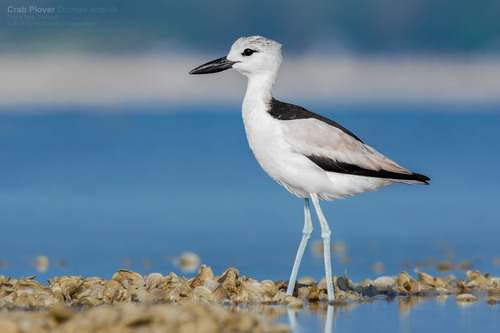
About Dromas ardeola Paykull, 1805
Overall Appearance
This bird resembles a plover, but has very long grey legs and a strong, heavy black bill similar to a tern's. Its black-and-white plumage, long-necked upright posture, and heavy bill make it distinctive and unmistakable.
Bill Specialization
Its bill is unique among waders, and is specialised for eating crabs.
Toe Structure
It has partially webbed toes.
Plumage Details
Its plumage is white, except for black on its back and on the primary feathers of its wings.
Vocalization Context
Crab-plovers are noisy birds, calling frequently at both their breeding sites and wintering grounds.
Common Call
Their usual call is a ka similar to that of the bar-tailed godwit, but it is repeated rapidly.
Flock and Breeding Calls
Flocks may produce a rising whinnying sound, and in the breeding season they produce whistling kew-ki-ki notes.
Sexual Dimorphism
Males and females are not easily distinguished, but males have a heavier and longer bill.
Juvenile Plumage
Juveniles have greyish black coloring on the mantle, and keep this plumage for a year.
Flight Formation
Flocks fly in lines or "V" formations.
Conservation Agreement
The crab-plover is one of the species to which the Agreement on the Conservation of African-Eurasian Migratory Waterbirds (AEWA) applies.
Distribution and Diet
The crab-plover is resident on the coasts and islands of the Indian Ocean, where it feeds on crabs and other small animals.
Feeding Behavior
They are gregarious and will feed in large groups, active at night, dawn, and dusk as well as during the day.
Activity Pattern
This crepuscular and nocturnal behaviour is more common during the breeding season.
Breeding Range and Timing
They breed around the Arabian Sea, Gulf of Oman, Persian Gulf, Red Sea, and Somalia from April to July.
Post-breeding Dispersal
In August, they disperse across the Indian Ocean as far east as the Andaman Islands and Sri Lanka, and as far south as Tanzania and Madagascar.


