About Drimia maritima (L.) Stearn
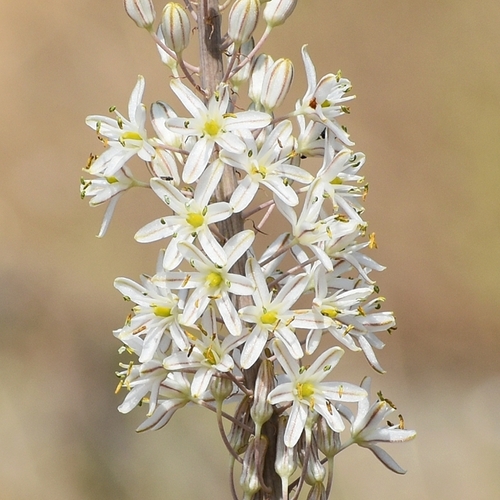
Drimia maritima (L.) Stearn grows from a large bulb that can reach up to 20 cm wide and weigh 1 kg; one report notes clumps of multiple bulbs weighing as much as 7 kg. Bulbs usually grow just below the soil surface, and several may grow together in one clump. Each bulb produces a spring rosette of around ten dark green, leathery leaves, each growing up to one meter long. These leaves die back by fall, when the bulb produces a tall, narrow raceme of flowers; this entire inflorescence can reach heights between 1.5 and 2 meters. Individual flowers are around 1.5 cm wide, with six tepals. Most tepals are white with a dark stripe running down the center, though a red-flowered form exists with red tepals. The plant produces a capsule fruit that grows up to 1.2 cm long. This species is most commonly found in rocky coastal habitats, and is widespread across the Mediterranean Basin. It can grow in many other habitat types, with the exception of the driest deserts, and tolerates both open, sunny sites and deeply shaded areas. Its growth pattern—producing leaves in spring and flowers in fall—is an adaptation to the Mediterranean climate of its native range, which has hot, dry summers. It has two distinct pollination syndromes: entomophily (pollination by insects) and anemophily (pollination by wind). Recorded insect pollinators include the western honey bee Apis mellifera, the Oriental hornet Vespa orientalis, and the paper wasp Polistes gallicus. This plant is very bitter, so most animals avoid it, but rats readily eat its tissue and die from the toxin scilliroside found in the plant. Because of this toxic effect on rats, Drimia maritima has been used as a rodenticide for nearly as long as it has been used medicinally. To prepare rodent bait, bulbs are dried, cut into chips, ground into powder, and mixed into bait. In the 20th century, the plant was introduced as an experimental agricultural crop, primarily to develop high-toxicity varieties for use as rat poison. Interest in this use increased after rats developed resistance to coumarin-based poisons. It has also been tested as an insecticide against the red flour beetle Tribolium castaneum. The main active compounds in Drimia maritima are cardiac glycosides, including unique bufadienolides: glucoscillaren A, proscillaridine A, scillaren A, scilliglaucoside, and scilliphaeoside. Cardiac glycosides can make up as much as 3% of the plant’s content, and scilliroside—the most important toxic compound—is present in all parts of the plant. Once the broad leaves have fully dried out, they lose their toxicity, and are eaten by cattle and sheep. In Palestine and Israel, Arab farmers use this plant to mark the boundaries of farm land, thanks to its distinct recognizable features. In Israel, it is traditionally considered a harbinger of fall; its Hebrew name hatzav shares a linguistic root with the words meaning to dig or quarry, referencing how the bulb grows into the ground. Drimia maritima has been used as a medicinal plant since ancient times. It is recorded in the 16th century BC Ebers Papyrus, one of the oldest surviving ancient Egyptian medical texts. Pythagoras wrote about the species in the 6th century BC; Hippocrates used it to treat jaundice, convulsions, and asthma, and Theophrastus was also familiar with the plant. Because the cardiac glycosides it contains have diuretic properties, its primary traditional medicinal use was to treat edema, then called dropsy. A solution of sea squill (the common name for this species) and vinegar was a common home remedy for centuries. The plant has also been used as a laxative and an expectorant. Pythagoras and Dioscorides recorded that people would hang bulbs with sprouted leaves outside their doors in spring to protect against evil spirits. In Greece, bulbs are still gathered and displayed during the winter as part of Christmas and New Year traditions. The tall inflorescences of Drimia maritima are also used as cut flowers in floristry.