About Dracophyllum traversii Hook.fil.
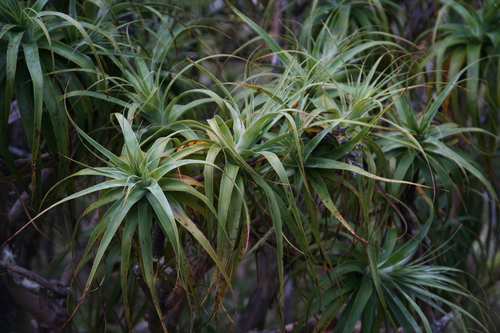
Dracophyllum traversii Hook.fil. is a shrub or tree that grows 0.2 to 13 meters (0.7 to 42.7 feet) tall; plants growing in exposed subalpine areas usually do not reach 1 meter (3.3 feet) in height. Similar to D. elegantissimum, it forms a candelabra-like canopy with its branches, which have flaky light brown bark. Its leaves, which cluster at the ends of branches similarly to species in the family Bromeliaceae, measure 9–86 cm by 1.7–5 cm (3.5–33.9 inches by 0.7–2.0 inches). They are leathery, with very fine teeth: there are 18 to 20 teeth every 10 mm (0.4 inches). Plants growing at the upper reaches of the tree line develop a grey wax coating on their leaves, and their leaves change color from green to reddish-purple in winter due to anthocyanins.
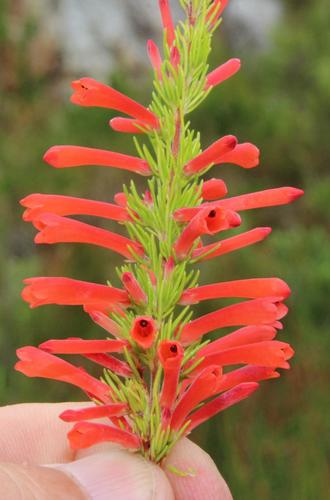
It flowers from October to February, producing densely packed panicles (branched inflorescences) that are 18–40 cm (7.1–15.7 inches) long. Panicles on plants growing in full sun may be shorter. Each panicle holds 500 to 3000 or more red (sometimes green) flowers. The panicle has a central axis 1.3–1.65 cm (0.51–0.65 inches) in diameter, with 3–6 cm (1.2–2.4 inches) long branches extending at right angles. It is covered in inflorescence bracts (modified leaves) that measure 130–240 mm by 25–50 mm (5.12–9.45 inches by 0.98–1.97 inches). These bracts are light green, with white at their base and pink at their tip. Its flowers are recaulescent, and hang from tiny 4.0–4.8 mm by 0.5–0.7 mm bracteoles, attached to 0.5–2.0 mm long hairy pedicels. The sepals are red (sometimes green), egg-shaped, and measure 1.2–3.0 mm by 1.1–2.5 mm, the same length as the corolla tube. The corolla (made of petals) itself is red, though the 2.7–3.0 mm by 4–5 mm bell-shaped tube is occasionally white. Its corolla lobes are reflexed, measuring 2.5–2.8 mm by 2.0–2.5 mm. The stamens are located at the top of the corolla tube: each consists of a 1.8–2.0 mm long oblong anther that is pink when fresh and turns yellow, suspended from a 1.0–1.5 mm long filament. The species has a 1.4–1.5 mm by 1.8–2.0 mm hairless, almost globe-shaped ovary, and 1.0–1.5 mm by 1.0–1.5 mm nectary scales. The stigma is five-lobed, with a 2–3 mm long style.
It fruits from December to May, producing yellow-brown egg-shaped seeds that are 0.95–1 mm long. The seeds are held inside hairless red to purple-brown fruits that measure 1.9–2.0 mm by 2.8–3.0 mm. D. traversii is morphologically very similar to D. latifolium, but differs in its more robust growth habit, as well as distinct leaf and flower traits. Its leaves have fine serrulate teeth, as opposed to the coarser serrate leaves of D. latifolium. It also has larger, hairless sepals, a longer and wider corolla tube, a globe-shaped ovary, and much smaller seeds than D. latifolium.
Dracophyllum traversii is endemic to New Zealand, found in both the North and South Islands. In the North Island, it occurs from Waima Forest south to Taumarunui, extending east to the East Cape. It is also found on the Coromandel Peninsula, Great Barrier Island, Little Barrier Island, and areas of the Central Volcanic Plateau. In the South Island, it occurs from north-west Nelson down to Fiordland and Central Otago. It grows across a wide vertical range, from sea level up to 1,768 m (5,801 ft), on steep gradients of 3 to 75 degrees. It is commonly found on gorges, mountainsides, saddles, and cliffs. It prefers full sun, but will also grow in partial shade. In 2023, the New Zealand Threat Classification System classified it as "Not Threatened", with an estimated population of at least 100,000 individual plants.
This species grows in lowland and subalpine shrubland, which may be dominated by only Olearia lacunosa; by Olearia colensoi, D. longifolium, and Coprosma; or only by Nothofagus menziesii. It also inhabits multiple types of lowland and subalpine forest: forest of Nothofagus menziesii, Lepidothamnus intermedius, and Weinmannia racemosa; forest of Nothofagus menziesii, Phyllocladus glaucus, and Weinmannia racemosa; forest of Libocedrus plumosa, Knightia excelsa, and Astelia fragrans; forest of Nothofagus menziesii and Gahnia rigida; and forest of Phyllocladus alpinus and Libocedrus bidwillii. Soils in its habitats are clay or clay loam formed from sandstone, limestone, graywacke, or shale.
Its seeds are dispersed by wind. While seeds do not have special wind-dispersal adaptations, their low mass allows them to travel sufficient distances. Haase calculated that seeds released from a height of 5 m (16 ft) in a 2 m/s (6.6 ft/s) wind would travel around 10 m (33 ft), twice the height of release. Since each panicle contains around 2500 flowers, he estimated one panicle produces 25,000 filled seeds, and a plant with a maximum of 30 such panicles could produce 750,000 seeds. He also estimated that D. traversii has a total lifespan of 500 to 600 years, with a juvenile stage that lasts between 100 and 150 years. It is deciduous, losing its leaves during the growing season, mainly from December through to March. Adult trees have an average annual wood increment of 0.4–0.49 mm, while juvenile trees have an average annual increment of 0.6–0.9 mm. Because it is deciduous, the area under D. traversii trees is often covered with deep leaf litter, reaching 10 cm (4 in) or more deep in some places, which prevents other plants from growing underneath. Typically, individual leaves are shed after six years, and full leaf growth takes 2–3 growing seasons, with each growing season occurring from approximately September to April. In his 2009 thesis, Venter recorded only one bird species pollinating D. traversii: Anthornis melanura, the New Zealand bellbird. This was the first recorded observation of bird pollination in this species. Seed germination is generally sporadic. Haase achieved an 80% germination success rate in 18 days, but this only occurred after 6–8 weeks of moist storage at 4°C. Seeds will not germinate without light.
For cultivation, Dracophyllum traversii is best propagated from seed and requires consistently moist soil. It is typically very slow growing and difficult to establish. It grows best in a semi-shaded area in humus soil. Wild-collected plants generally die within a few months after being transplanted into cultivation.