About Dracophyllum muscoides Hook.fil.
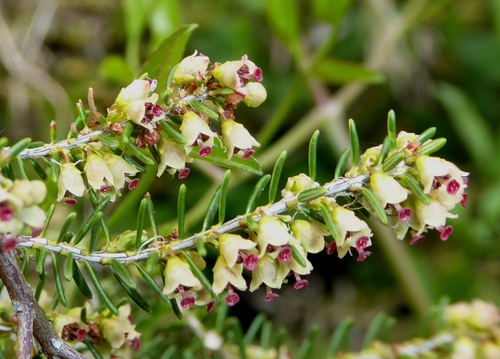
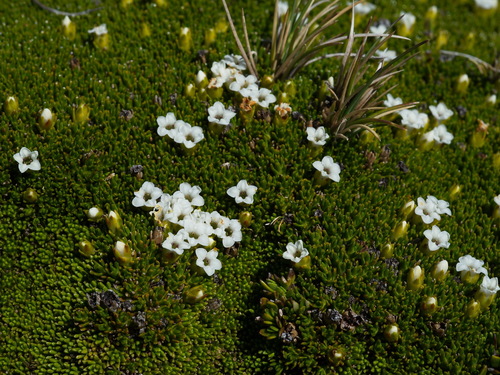
Dracophyllum muscoides Hook.fil. (commonly referred to as D. muscoides) grows as a small cushion, reaching only 15–50 mm (0.6–2.0 in) in height, even though it produces upright branches. It has heavily branched stems covered in greyish-brown bark, while new growth is reddish-brown. Its leaves are arranged in a spiral pattern around branches, overlapping and pressing against one another. The olive green leaves measure 1–3 mm by 0.3–0.8 mm, and are held within light green sheaths that measure 1.5–3 mm by 1.5–3 mm. The narrow leaves have tiny teeth along their front third, with 5–10 teeth per centimeter. Flowering takes place from December to May, and produces small white flowers. Each flower grows on a sessile terminal inflorescence. The flowers consist of oval sepals that measure 1.5–4.5 mm by 1.5–2.0 mm, growing out of a 2.0–2.5 mm by 1.5–3.5 mm white bell-shaped corolla tube. The corolla tube has glabrous lobes that measure 1.0–1.5 mm by 1.0–1.5 mm. In the upper third of the flower is the stamen, which is made up of 0.8–1.0 mm long light yellow anthers carried on 0.2–0.5 mm long filaments. This species also has a 1.4–1.5 mm by 1.3–1.4 mm ovary, and 0.5–0.9 mm by 0.5–0.7 mm nectary scales. Fruiting occurs from February to August, producing fruit that measures 1.0–1.1 mm by 0.8–1.0 mm. Inside the fruit are 0.5–0.6 mm long yellowish-brown oval seeds, which are dispersed by wind. D. muscoides is endemic to New Zealand, and is only found in the South Island of New Zealand, from Mount Hercules southward. It grows in sub-alpine herbfields, boulderfields, grassland, and alpine bog, at elevations between 914–2,600 m (3,000–8,530 ft) above sea level.