About Dracophyllum milliganii Hook.fil.
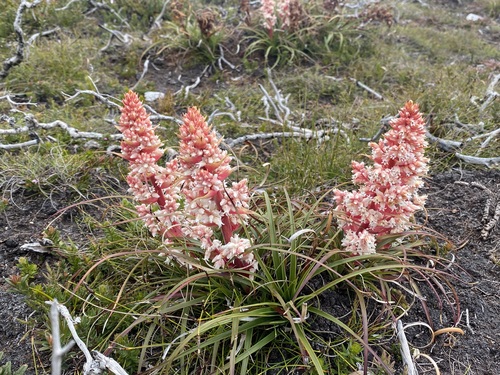
Dracophyllum milliganii is split into two distinct populations that have notably different appearances and occupy different habitats. In alpine and sub-alpine heathland, this species grows as a graminoid shrub that reaches 5 to 20 cm in height, and bears curling leaves up to 20 cm long. In alpine rainforests and wet sclerophyll forests, it grows as an erect shrub or small tree, with stems that can grow up to 4 metres tall and leaves that are 1 to 1.5 metres long, and has a growth habit similar to Richea pandanifolia.
Living leaves are dark green with very finely toothed (serrulate) margins, and dead leaves turn grey-brown. The leaves are sheathing at their base and grow in highly crowded clusters. The inflorescence is a terminal flower spike that has a thick red stem, and holds small white to pink flowers that are fused into a tubular shape. While D. milliganii leaves are similar in appearance to those of Richea pandanifolia, the two species differ: R. pandanifolia is a large erect tree that grows in rainforests, produces small flowers that emerge from the stem axis, and has coarsely toothed (serrate) leaf margins.
This species is endemic to western and south-western Tasmania. It is found in alpine areas located above 850 metres in altitude, though its rainforest form can grow at lower altitudes. It grows in harsh, open alpine sites on peaty or well-drained rocky soils in areas that are regularly covered by snow. Along with Isophysis tasmanica, the presence of Dracophyllum milliganii helps identify Tasmanian highland treeless vegetation communities, as it occurs in western alpine heathland (HHW) and cushion moorlands (HCM).