About Dracophyllum arboreum Cockayne
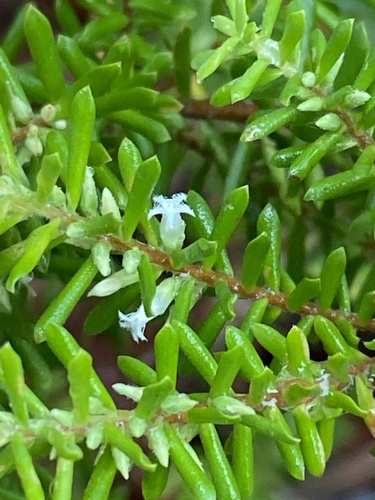
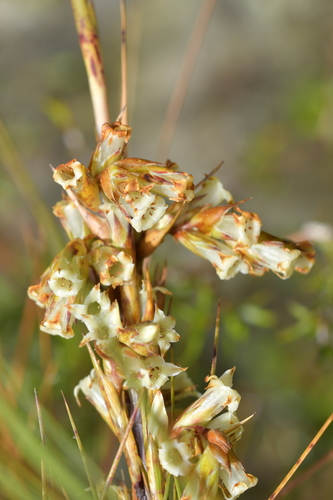
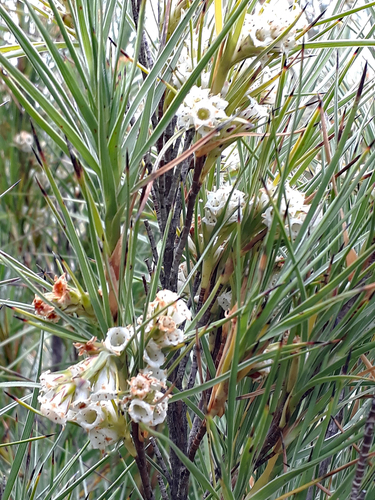
Dracophyllum arboreum, formally Dracophyllum arboreum Cockayne, is a tree that reaches a height of 4–18 m (13–59 ft). It has greyish brown bark, and new growth is reddish brown to yellow. This species has dimorphic leaves, meaning leaves differ dramatically between juvenile and adult life stages. Juvenile leaves are green, leathery, measure 10–22 by 1–1.8 cm (3.94–8.66 by 0.39–0.71 in), and are completely hairless except for dense tiny hairs along their edges. Adult leaves, by contrast, are narrow, needle-like, and measure 25–90 by 1–2 mm (0.98–3.54 by 0.04–0.08 in). They are hairless except for tiny hairs covering their margins and a tuft of hair on the top side at the base. Flowering occurs from November to February, producing spiked terminal inflorescences (flower clusters) that grow from lateral branchlets. Each inflorescence holds 4–9 flowers, measures 15–38 mm (0.59–1.50 in) long, shorter than the species' leaves, and has an inflorescence bract that measures 18–20 by 3–5 mm (0.7–0.8 by 0.1–0.2 in). Like the leaves, inflorescences are mostly hairless except for hairs around their margins and many hairs at the base of the upper side. The flowers are sessile, meaning they attach directly to the stem, are white and elliptically shaped, and measure 5.5–9 by 2.5–3 mm. The corolla (petals) is also white, cylindrically shaped, measures 4–5 by 2.5–3.0 mm, and has reflexed triangle-shaped lobes. The leaf-like sepals are white, egg-shaped, measure 4.0–7.0 by 2.5–3.0 mm, and are longer than the corolla tube. Stamens are located in the upper third of the corolla, each made of a 0.3–0.4 mm long light yellow anther atop a 0.3–1 mm long filament; filament length varies between populations. The species also has a 1.7–2 by 1–2 mm hairless elliptically shaped ovary, 1.0–1.2 by 0.5–0.8 mm rectangular nectary scales, and a 2–2.5 mm long hairless style. Fruiting occurs year round, producing sessile dark brown rectangular fruit that measures 1.2–1.5 by 1–1.5 mm, which contains a 0.6–0.65 mm long yellowish-brown egg-shaped seed. D. arboreum is similar to D. scoparium and D. cockayneanum, but differs primarily by having juvenile leaves, which D. scoparium lacks. It is more similar to D. cockayneanum, but can be distinguished by D. cockayneanum's much smaller hairy juvenile leaves and non-persistent floral bracts. D. arboreum's adult leaves also taper to a point and only have hairs on the edges and base of the top side, while D. cockayneanum's adult leaves are more rounded and covered with hairs all over. This species is endemic to the Chatham Islands, an island chain around 800 km (500 mi) east of New Zealand's South Island, and occurs on Chatham, Rangiuria, and Rangatira Islands. It is abundant on Chatham Island's southern tableland, in lowland forests, drier areas of swamps, and the transition zone between moorland and forest, where it associates with D. paludosum, particularly in its juvenile form. On Rangiuria Island, also known as Pitt Island in English, D. arboreum dominates upland forest alongside Rautini (Brachyglottis huntii) and various tree fern species. It grows from near sea level up to 270 m (886 ft), on cliffs, hillsides, streams, gullies, and valley floors. These habitats typically support forests, shrublands, bogs, and grasslands, and often have boggy, peaty soil. D. arboreum typically prefers full sun, though it will also grow in light shade. In 2017, the New Zealand Threat Classification System classified this species as "Naturally Uncommon", with an estimated occupied area of 10 km² (1,000 ha). The forests it occurs in are primarily composed of Plagianthus regius subsp. chathamicus, and its associated shrubland communities are one of three types: large-leaved muehlenbeckia (Muehlenbeckia australis); Coprosma species alongside Chatham Island aster (Olearia semidentata); or Olearia chathamica. The Chatham Islands are extremely windswept, with an average annual wind speed of 24 km/h (13 kn), and recorded extreme wind speeds of 157 km/h (85 kn) in January 1993, and 124 km/h (67 kn) a few months later. To adapt to these conditions, D. arboreum evolved to be heteroblastic: it develops large leaves as a juvenile, which become thin, wind-resistant needles at maturity. Many mainland New Zealand plant species are also heteroblastic, such as lancewood, but this is thought to be an adaptation to browsing by now extinct large moa birds. The Chatham Islands never had moa, so D. arboreum likely evolved this heteroblastic trait due to climatic factors like constant wind, with thinner leaves reducing stress on plant stalks. D. arboreum can also grow as an epiphyte, usually beginning its life in a tree fern, before extending its roots downward and eventually developing a trunk. D. arboreum can be cultivated from seed, but it is difficult to maintain. It prefers a damp, acidic, peaty soil, matching its native habitat on the Chatham Islands.