About Dracaena trifasciata (Prain) Mabb.
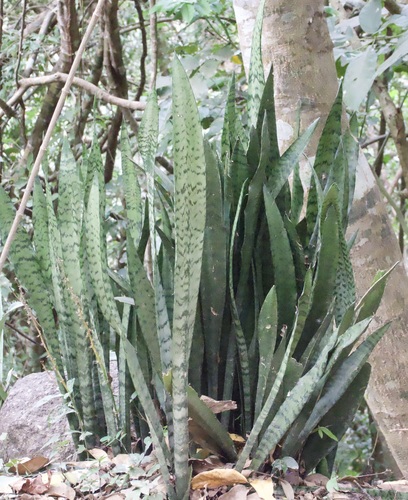
Dracaena trifasciata (Prain) Mabb. is an evergreen perennial plant that forms dense clumps, spreading via a creeping rhizome that may grow either above or below ground. Its stiff leaves grow upright from a basal rosette. Mature leaves are dark green with light gray-green cross-banding, and typically measure 70 to 90 centimetres (2.3 to 3.0 feet) long and 5 to 6 centimetres (2.0 to 2.4 inches) wide. In optimal conditions, the plant can reach total heights over 2 meters (6 feet). The specific epithet trifasciata translates to 'with three bundles'. This plant uses the crassulacean acid metabolism process to exchange oxygen and carbon dioxide, which allows it to tolerate drought. Unlike many plants, it opens its microscopic leaf gas-exchange pores, called stomata, only at night to prevent water loss from evaporation during hot daytime sun. Getting this plant to bloom outside of its natural environment is difficult, but it is possible to replicate its natural growing conditions. When it does bloom, its flowers range in color from greenish white to cream-colored. Some blooms release fragrance at night, while others are unscented, and all have a sticky texture. Dracaena trifasciata is commonly known by common names including 'mother-in-law's tongue', 'Saint George's sword', and 'snake plant', all named for the shape and sharp margins of its leaves that resemble snakes. It is also called 'viper's bowstring hemp', as it is one source of plant fiber used to make bowstrings. Like other species in its genus, D. trifasciata produces bowstring hemp, a strong plant fiber once used to make bowstrings. Today, it is primarily grown as an ornamental plant. It is planted outdoors in warmer climates, and grown indoors as a houseplant in cooler climates. It is very popular as a houseplant because it tolerates low light levels and irregular watering; during winter, it only needs to be watered once every few months. It will develop root rot easily if overwatered. It is often recommended as a good starter houseplant for new gardeners, because it requires very little care. The NASA Clean Air Study found that D. trifasciata has the potential to filter indoor air, and can remove four out of the five main toxins linked to the negative effects of sick building syndrome. However, its filtration rate is too slow to work effectively for practical use in most indoor spaces. D. trifasciata can be propagated by cuttings or by dividing the rhizome. Propagation via cuttings has the disadvantage that the leaf variegation of the parent plant will be lost in new growth. Some authorities consider D. trifasciata a potential invasive weed in Australia. It is widely used as an ornamental plant outdoors in tropical regions, grown in pots and garden beds, and kept as an indoor plant in temperate regions. The plant contains saponins that are mildly toxic to dogs and cats, and can cause gastrointestinal upset if the plant is consumed. In South Africa, the plant is used to treat ear infections.