About Dracaena draco (L.) L.
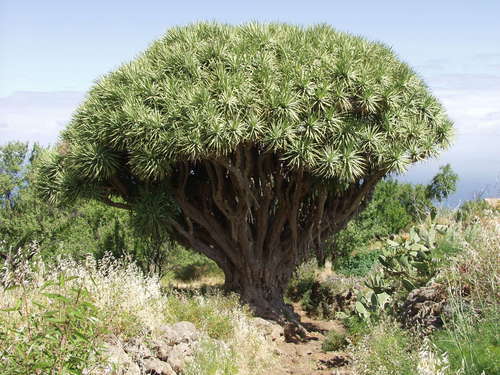
Dracaena draco (L.) L., commonly called the dragon tree, is an evergreen long-lived monocot tree currently classified in the asparagus family (Asparagaceae, subfamily Nolinoidae). Mature specimens can exceed 15 m (49 ft) in height, with a trunk circumference of 5 m (16 ft) or more. Young trees have a single stem and smooth bark; as the tree ages, bark becomes rough in texture. When a young stem reaches 10–15 years of age, it stops elongating and produces a flower spike with white, lily-like fragrant flowers, which are followed by coral berries. A crown of terminal buds then forms, and the tree begins branching. Each branch grows for 10–15 years before branching again, giving mature plants an umbrella-like growth habit. Growth is slow overall, with trees typically taking around 10 years to reach 1.2 metres (4 ft) in height, though some individuals grow much faster. Unlike most monocotyledons, Dracaena draco produces annual growth rings. There is substantial genetic variation among Canary Island dragon tree populations. The form native to Gran Canaria is now recognized as a separate species, Dracaena tamaranae, due to differences in flower structure. The form endemic to La Palma branches very low on the trunk, producing numerous nearly vertical branches arranged in a fastigiate habit; a forest of these La Palma dragon trees grows at Las Tricias, Garafia district, La Palma. Three subspecies were previously recognized: D. draco subsp. draco, endemic to Madeira and the Canary Islands; D. draco subsp. ajgal Benabid & Cuzin, endemic to Morocco; and D. draco subsp. caboverdeana Marrero Rodr. & R.S.Almeida, endemic to the Cape Verde islands. Plants of the World Online currently treats the Moroccan and Cape Verdean forms as separate species: Dracaena ajgal and Dracaena caboverdeana. Dracaena draco is native to Macaronesia and southwest Morocco, and is widely cultivated as an ornamental plant. On the Canary and Madeira archipelagos, surviving wild endemic populations are currently only known from Tenerife and Madeira, after the species recently went extinct in the wild in Gran Canaria. Wild Moroccan populations extend into the southwest Atlas Mountains. The origin of the species on the Azores is uncertain: it is thought to have been introduced by Portuguese settlers before 1500 using seeds from Madeira and Cape Verde, and some Azorean individuals show similarities to the Cape Verdean subspecies (subsp. caboverdeana). There are around 200-300 individuals growing on remote sites of São Jorge island, plus a small number more on other Azorean islands, and it remains unknown whether these populations are native or derived from early introduction. When the bark or leaves of Dracaena draco are cut, they secrete a reddish resin that is one source of the substance known as dragon's blood. The red color of this resin comes from a high content of mono- and dimeric flavans. Dragon's blood has a number of documented traditional medical uses, though dragon's blood from Dracaena draco was not known to outside cultures until the 15th century. Analyses indicate that most dragon's blood historically used in art was obtained from species of the genus Calamus, which were formerly placed in the genus Daemonorops. The secretory tissues that produce dragon's blood in Dracaena draco are located in both the primary and secondary plant body, including ground parenchyma cells and cortex cells. Dragon's blood from Dracaena draco can be distinguished from dragon's blood from Dracaena cinnabari by differences in 10 compounds, and by the absence of the dominant flavonoid DrC11, which is present in Dracaena cinnabari. The Guanches of Tenerife worshiped a large historic specimen of Dracaena draco, and hollowed its trunk to create a small sanctuary. Alexander von Humboldt observed this tree during his visit; it measured 70 feet (21 m) tall, had a circumference of 45 feet (14 m), and was estimated to be 6,000 years old. The tree was destroyed by a storm in 1868. Dracaena draco is cultivated and widely available as an ornamental tree for parks, gardens, and drought-tolerant water-conserving sustainable landscape projects. It has been awarded the Royal Horticultural Society's Award of Garden Merit. In 2017, the city of Angra do Heroísmo on Terceira Island planted a grove of 200 dragon trees. The Museum of Wine on Pico Island, Azores, holds one of the largest concentrations of Dracaena draco in Macaronesia, with some specimens older than 100 years.