About Dracaena cinnabari Balf.f.
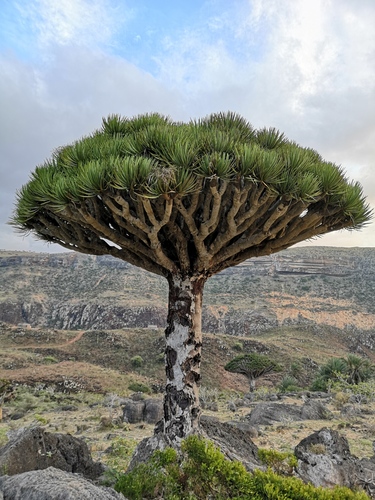
Dracaena cinnabari, commonly called the dragon blood tree, is an evergreen species with an upturned, densely packed crown. It gets its common name from its dark red resin, known as "dragon's blood". Unlike most monocot plants, Dracaena species undergo secondary growth; D. cinnabari even has growth zones that resemble the tree rings of dicot tree species. Along with other tree-like Dracaena species, it has a distinct growth form called "dracoid habitus". Its leaves grow only at the ends of the youngest branches, and are shed every three to four years, while new leaves mature at the same time. Branching typically occurs when the terminal bud stops growing, either from flowering or traumatic events such as herbivory. This tree can reach up to 9 meters (30 feet) in height, with a crown up to 12 meters (39 feet) across, and a trunk that reaches up to 1.5 meters (4 feet 11 inches) in diameter at breast height. D. cinnabari produces small fleshy berry fruits that contain between one and four seeds. As the berries develop, they change color from green to black, then turn orange when fully ripe. Birds such as species of Onychognatus eat these berries, which disperses the tree's seeds. The seeds measure 4–5 mm (0.16–0.20 in) in diameter and weigh an average of 68 mg. Both the tree and its berries exude a deep red resin known colloquially as dragon's blood. Like other monocotyledons such as palms, the dragon's blood tree grows from the tip of its stem, with long, stiff leaves held in dense rosettes at the stem end. When mature, it branches to form an umbrella-shaped crown; its individual leaves grow up to 60 cm (24 in) long and 3 cm (1.2 in) wide. The trunk and branches of D. cinnabari are thick and stout, and show dichotomous branching, where each branch repeatedly divides into two separate sections. Dragon blood trees are harvested for their crimson red dragon's blood resin, which was highly valued in the ancient world and remains in use today. In the Mediterranean basin, the resin is used as a dye and a medicine. On Socotra, local people use it ornamentally, to dye wool, glue pottery, as a breath freshener, and as lipstick. The root of the tree produces a gum-resin that is added to gargle water as a stimulant and astringent, and is used in toothpaste. The root is also used to treat rheumatism, while the leaves act as a carminative. In 1883, Scottish botanist Isaac Bayley Balfour identified three grades of D. cinnabari resin: the most valuable had a tear-like appearance, the next grade was a mixture of small chips and fragments, and the cheapest grade was a mixture of fragments and debris. D. cinnabari resin was thought to be the original source of dragon's blood, until other plants were used as sources instead during the medieval and renaissance periods. Due to the belief that it is the blood of a dragon, the resin is also used in ritual magic and alchemy. Local people on Socotra Island have long used dragon's blood resin as a cure-all. Greeks, Romans, and Arabs used it for general wound healing, as a coagulant, to treat diarrhea and dysentery, to reduce fevers, and to address ulcers of the mouth, throat, intestines, and stomach. In the 18th century, D. cinnabari dragon's blood was used as a varnish by Italian violin makers, and was also used as an ingredient in toothpaste. It is still used today as a varnish for violins and for photoengraving. A 16th-century text, Von Stahel und Eysen, lists dragon's blood as an ingredient in the quenching bath used for tempering steel.