About Draba verna L.
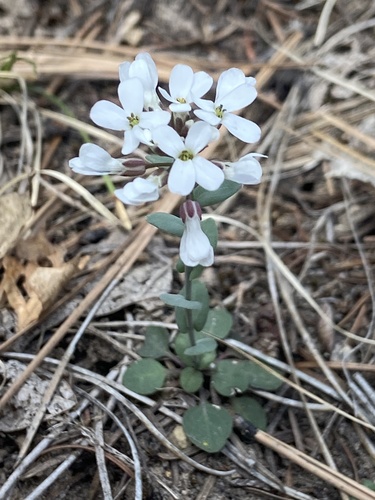
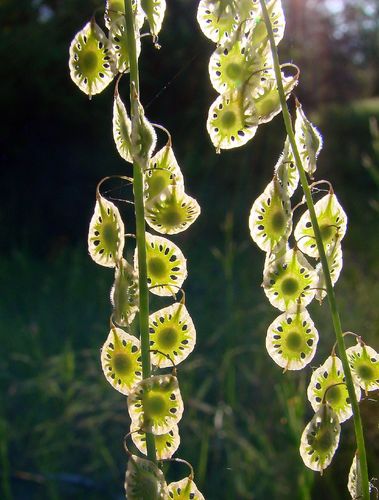
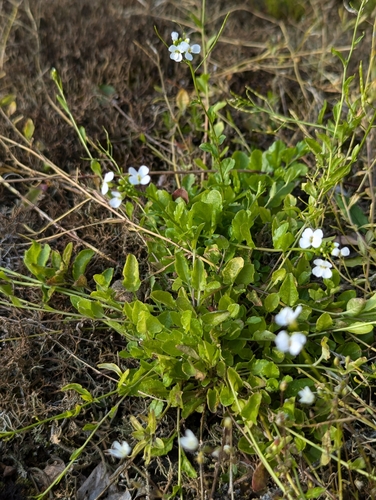
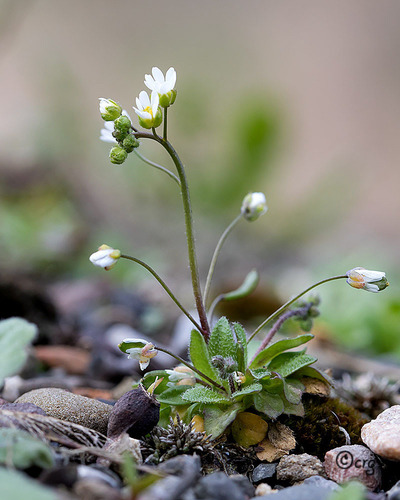
Draba verna L., commonly known as common whitlowgrass, is a spring-flowering annual plant. It typically reaches up to 10 cm (4 in) in height, though it may occasionally grow as tall as 25 cm (10 in). It produces a basal rosette of leaves and one or more leafless flowering stems. Hairs on the plant are variable: individuals may be nearly completely glabrous (hairless), especially on the stems. Its elliptical leaves grow up to 20 mm (1 in) long, exceptionally up to 35 mm (1.4 in), and up to 8 mm (0.3 in) wide. Leaves are usually smooth-edged, but sometimes have a single tooth on one or both margins, and taper gradually into a more-or-less distinct petiole. Leaf surfaces and margins are usually scattered with forked, Y-shaped hairs at the tips. The central leaf vein is faintly visible on the upper leaf surface and easily distinguishable on the underside. Mature leaves may turn reddish in colour. Flowering occurs in early spring, from March to May in northern latitudes. Each of the one or more stems bears a loose raceme of around 10 long-stalked flowers. Each flower has 4 white petals roughly 3 mm (0.1 in) long; the petals are so deeply bifid (divided) that flowers can appear to have 8 petals instead of 4. Flowers also have 6 stamens with yellow anthers and a single style. Sepals are around 2 mm (0.1 in) long, green, hairy, and often have a purplish margin. As a result of self-pollination, the fruit, called a silique, develops immediately after flowering while petals are still present. The silique is oval to elliptical, flattened, and grows up to 9 mm (0.4 in) long by 3 mm (0.1 in) wide, with a persistent style at its tip. Each silique holds around a dozen round seeds arranged in two valves. When the valves split open, they leave behind a transparent membrane between them, resembling a small version of an honesty seedpod. Seeds remain dormant through the summer, and require approximately 3 months of after-ripening before they can germinate successfully. During this after-ripening period, seeds need 5 to 7 weeks of sunlight to germinate well in autumn. Experimental studies have found that seeds germinate most successfully at 50% to 60% relative humidity. This species is very easy to identify by the combination of its deeply bifid petals, which can give the false impression of 8 petals per flower, and its leafless stems. It is much more difficult to distinguish from the closely related segregate species D. majuscula and D. praecox, if those segregates are accepted as separate species. Useful field identification characters for this separation include the depth of petal division, the hairiness of leaves and stems, and petiole length. Common whitlowgrass is native to Europe, western Asia, and parts of North Africa extending south to Ethiopia. It is also widely naturalized in temperate regions of the Americas, Australia, New Zealand, and Japan. It has been hypothesized that it was introduced to North America by European colonizers. It is sometimes listed as an invasive species in introduced regions such as the United States, but there is no evidence that it causes any harm. Its global conservation status has not been assessed, but it is generally listed as Least Concern in countries where it is native. Common whitlowgrass grows in almost any location with bare soil, including typical habitats such as limestone pavements, sand dunes, field margins, urban pavements, and quarry waste. Its Ellenberg values in Britain are L = 3, F = 3, R = 6, N = 3, and S = 0, which indicates it favours relatively dry, neutral soils with low levels of fertility. The UK's database of Insects and their Food Plants records just 4 insect species that feed on common whitlowgrass. Three of these are weevils: the cabbage leaf weevil Ceutorhynchus contractus, the cabbage stem weevil C. quadridens, and C. hirtulus. The fourth is the orange tip butterfly, a common species whose larvae feed on flowers of plants in the cabbage family. Two species of downy mildew infect common whitlowgrass, particularly when the plant is experiencing water stress. Hyaloperonospora erophilae coats the leaves and turns them chlorotic, while H. praecox produces more localized, less obvious symptoms. The two species can be told apart by differences in their haustoria. There are no recorded modern uses for common whitlowgrass. In the 1600s, Nicholas Culpeper wrote that it was exceedingly good for treating abscesses in the joints and under the nails known as whitlows, felons, andicorns, and nail-wheals. However, researcher Vickery has found that common whitlowgrass was never actually used in folk medicine in Britain or Ireland, and it is not mentioned in American herbals. It is presumed that Culpeper assigned this medicinal property to the plant according to the doctrine of signatures, due to the unusual shape of its leaves.